 |
|
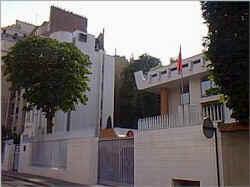
Vietnam embassy |
 Avenue de Versailles, right
into Exelmans where at no.39 Guimard, surelevated the very classic atelier of
Carpeaux, left in rue Boileau. The rue Boileau is one of the most typical of
this area. Avenue de Versailles, right
into Exelmans where at no.39 Guimard, surelevated the very classic atelier of
Carpeaux, left in rue Boileau. The rue Boileau is one of the most typical of
this area.
At 38, the Hameau Boileau, a house complex with slate roofs. At n° 40 is the
Algerian embassy, with a typical Art Nouveau decoration. No comes the Vietnam
embassy at no.62 built by architect Vo Thanh Nghia in 1977. A mixture of
traditional Asian and contemporary architecture: pagoda roof, terracotta tiles,
greenery penetrating into the building.
At 34, first hotel particulier build by Guimard in 1891,the hotel Rosze dating
1891. At no. 25, rue Claude-Lorrain and rue Boileau: villa "Dietz-Monnin.
In
rue Claude Lorrain: les Trois Villas at no.25 is a return to the calm and
tranquillity of a village. We are near and at the same time far away from the
great traffic axes. It's worth the detour.
One of the three villas, villa Dietz-Meyer smells rose bushes and is
crossed by several paved paths. Small one story pavilions preceded by small, quaint
gardens. Another interesting house on rue Chardon-Lagache no 4
(1893), the hotel Jassede.
We are very near to the forgotten and discreet cemetery of Auteuil so let’s
have a look? Not to compare to the Montmartre or Montparnasse cemetery it houses
a few celebrities anyway. The
best known are the composer Gounod, Hubert Robert, founder of the famous
newspaper "Le Figaro", movie director Abel Gance. That’s not enough
to attract huge crowds.
From the cemetery take the rue Michel-Ange to the rue Molitor. At a certain
moment look out for the entrance of this little jewel: the villa Molitor. A
really beautiful little village, charming, with neatly lined trees in the
alleys, old lamp post and a lot of hotels particuliers, only fir for the very
wealthy.
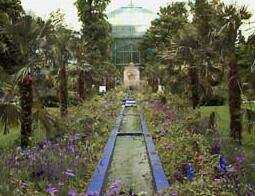 Avenue de la Porte-d'Auteuil, 3, THE AUTEUIL GREENHOUSE, build end 19th century.
The iron and glass serres, or greenhouses, were constructed to assure the Paris parks a constant supply of seasonal flowers, trees and assorted verdure. In 1968, when the construction of the peripherique cut down the gardens to a third of their size, the
"plant wares" were moved out to Rungis, along with the Les Halles markets.
Avenue de la Porte-d'Auteuil, 3, THE AUTEUIL GREENHOUSE, build end 19th century.
The iron and glass serres, or greenhouses, were constructed to assure the Paris parks a constant supply of seasonal flowers, trees and assorted verdure. In 1968, when the construction of the peripherique cut down the gardens to a third of their size, the
"plant wares" were moved out to Rungis, along with the Les Halles markets.
But the botanical gardens and ornamental greenhouses, classified as historical monuments, remain a showplace for exotic species. The Serres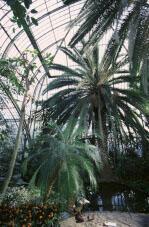 boast, for instance, a collection of over 4,000 orchid varieties alone. Strolling through the pleasantly perfumed gardens brings to mind the Joni Mitchell song about a tree museum (...and charge the people a dollar and a half just to see
'them). boast, for instance, a collection of over 4,000 orchid varieties alone. Strolling through the pleasantly perfumed gardens brings to mind the Joni Mitchell song about a tree museum (...and charge the people a dollar and a half just to see
'them).
Each plant and tree is identified and labelled. There's a towering cedar of Lebanon, a 100-year-old American sugar maple, an Italian jasmine bush, the Bird of Paradise from South Africa, trees and flowers from India, Brazil, Taiwan and the Philippines. In fact, the park boasts 260 trees and more than 24,000 different plants - as well as a supply of park benches for contemplation of it all.
Continue rue Michel-Ange
and via rue La Fontaine enter at your left the rue Pierre-Guerin and continue.
Starting rue de la Source you find Another example how certain areas in Paris
can project you suddenly completely in another era, another century. It's a
blind alley, with not very well cared off paved stones, no traffic, no noise,
complete quiet.
On the rue du Ranelagh where you will soon arrive again, you can see the lyceum
Moliere built in 1886. Try to enter the 2 interior
courtyards, act like a student or a professor…? It's impressive. Closed on Saturday afternoon and Sundays. Another unique villa is
lying in the avenue du Beausejour: the " villa Beausejour". In a very
quiet atmosphere, 3 chalets that were built in the second half of the 19th
century. Timber logs, sculpted decorations.
To stop about Auteuil and Passy, let’s look at a State owned building, the
“Maison de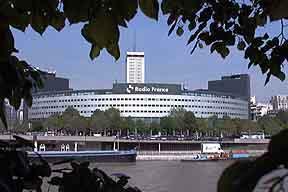 Radio France”.
Built between 1953 and 1963, by architect Bernard, it is the home of Radio France.
The cylindrical building of 500 metres in circumference and tower 68 metres high make it
unmistakable and therefore it is called the "round
house”. It was accepted right away by the public: very rare and that's why I
emphasizes it. The great external crown houses about thousand small offices and
studios. The small crown all technical devices, direction and centres de
diffusion. A 23 stories tower houses the archives. Three thousand people work in
this building. Radio France”.
Built between 1953 and 1963, by architect Bernard, it is the home of Radio France.
The cylindrical building of 500 metres in circumference and tower 68 metres high make it
unmistakable and therefore it is called the "round
house”. It was accepted right away by the public: very rare and that's why I
emphasizes it. The great external crown houses about thousand small offices and
studios. The small crown all technical devices, direction and centres de
diffusion. A 23 stories tower houses the archives. Three thousand people work in
this building.
Inside, the Museum of the History of Radio and Television, retracing the history of information transmissions from the Roman era
 until today. Like the optical telegraph of the brothers Chappe (1793) and the
Morse telegraph (1832), the Bell telephone (1876),
… There are also exhibits featuring research by Maxwell, Hertz, Branly, Popov, Marconi, and Lee de Forest.
until today. Like the optical telegraph of the brothers Chappe (1793) and the
Morse telegraph (1832), the Bell telephone (1876),
… There are also exhibits featuring research by Maxwell, Hertz, Branly, Popov, Marconi, and Lee de Forest.
Nearby on the Pont de Grenelle,
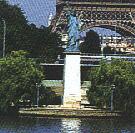
on the Ile aux Cygnes, is a smaller version, by Collas, of Bartholdi's Statue of Liberty - the larger version of which welcomes visitors to New York's harbour. The original is in the entry of the
harbour of New York. L' Ile aux Cygnes got the name because Louis XIV populated it with a flock of them. The statue stands on this island in the Seine just south of the Pont de Grenelle, facing the Maison du Radio.
It's on that spot that the Protestants killed
in the "massacre de la Saint-Barthelemy" were buried. Although one source says it was inaugurated on 12. May
1885, another says it was not done until 1937. The problem was that the President of the time refused to do it in a boat - which was the only way it could be done to its face - which is apparently the rule for statues.
Bibliography
--Vie
et histoire des arrondissements de Paris, ed.Hervas (1985-1988--Nouvelle
Histoire de Paris, ed.Hachette--Le Pieton de Paris, by L.P.Fargue, ed.Gallimard
199 --Dictionnaire historique des rues de Paris, by J.Hillairet, ed.Minuit
--Guide du Routard 1998-1999 (Ed.Hachette)--Paris, 2000 d'histoire, by J.Favier,
ed.Fayard 1997—Paris en quartiers : le Nord, by J.Lacouterie (ed.Hervas
185)—Le 16eme, Passy, Auteuil et ses anecdotes, by B.Beyern (own folders)
|
