|
The rue Berton, that we take
now, kept the looks of a village street.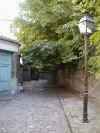
Continue the rue Raynouard and soon you’ll walk in the rue La Fontaine, where
La Fontaine, Boileau and Moliere used to live. Be prepared for a real
architectural promenade. You will learn all about a famous Parisian architect,
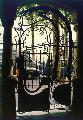
Hector Guimard(1868-1942), whose houses are scattered all over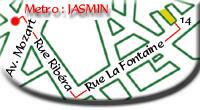 the area. Already here, in the rue La Fontaine, at no.14 is the very famous Castel Beranger (1897)
considered by many the masterpiece of Guimard. Contemporaries named this building Castel Dérangé
(deranged mentally) because of the real crazy mix of different styles, materials and shapes, unusual also for Art
the area. Already here, in the rue La Fontaine, at no.14 is the very famous Castel Beranger (1897)
considered by many the masterpiece of Guimard. Contemporaries named this building Castel Dérangé
(deranged mentally) because of the real crazy mix of different styles, materials and shapes, unusual also for Art
 Nouveau artists. Guimard introduced Art Nouveau in Paris. He brought it from
Brussels in 1894 when he visited Victor Horta. The owner of the property, Mme.
Fournier, must have had a lot of courage to accept the design of Guimard (quite
unknown at that time) for the building but she was rewarded when the facade
obtained the medal of the nicest facade in Paris in 1899. Nouveau artists. Guimard introduced Art Nouveau in Paris. He brought it from
Brussels in 1894 when he visited Victor Horta. The owner of the property, Mme.
Fournier, must have had a lot of courage to accept the design of Guimard (quite
unknown at that time) for the building but she was rewarded when the facade
obtained the medal of the nicest facade in Paris in 1899.
 |
|
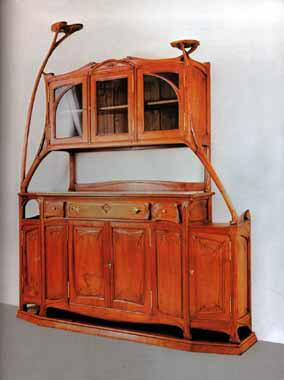
Guimard Art Nouveau buffet |
The first two floors and the
left side part of the Castel will be built in red bricks and for the rest he
will take an option on pale pink bricks.
Being a man of
his time, Guimard will not neglect financial costs and take the property price
into consideration. Not an inch will be lost, like for the concierge lodge where
he will use the turn of the staircase. Even the
wallpaper had to been at moderate rent. It’s enough to have a look at the
courtyard reuniting three buildings in the Impasse Beranger to realize the art
which Guimard had to rentabilize a terrain. The least you can say about is that
you don't notice any austerity: a mix of millstone grit, steel, wrought iron,
stained-glass windows. It’s this building that definitively rocketed him as an
architect-artist.
This very agreeable avenues thanks to its trees and boutiques with
here and there some hotels particuliers, has a lot of anecdotes: if on 10th May
1874 a window would open on no.96, by passers would have heard the baby cries of
Marcel Proust! At no.10, on the same street, just near to Castel Beranger,
Guillaume Apollinaire moved in and that's where he will meet Marie Laurencin.
Rue Agar, Guimard realized at the same epoch (1910) several houses mainly in
brick with a limited décor but very varied. Rue Millet no.11, Guimard’s
building “Tremois” in a severe style.
Rue d’Auteuil, once the main street of the village, changed quite a lot but
kept its countryside character with numerous low houses without décor,
contrasting with the large buildings of the neighbouring streets. Don’t forget
that Auteuil was always chic, provincial and discreet. The famous Arletty lived
in the rue Remusat and the famous Guimard, of who we are talking a lot now;
designing its famous Jugendstil style entrances of the metro, lived in rue La
Fontaine and rue Agar. The enchanting like bewitched castle “Lycee Jean-Baptiste-Say"
of the 17th century stays in between. At the square du Docteur
Blanche, the Foundation Le Corbusier is housed in the Villa La Roche, built for
a Swiss banker and art collector, Roal La Roche. The neighbouring rue Poussin has at no.12 the villa de Montmorency that
had a splendid park under Louis XVI. This very quiet spot attracted a lot of
intellectuals: Goncourt, Andre Gide, Bergson…. It’s a nice example of well
guarded little cité.
Avenue
Mozart at 122 Guimard built in 1910 a hotel of 4 floors with loggia, another at
120 is also his but much more severe and looking more as the houses rue Agar.
From the avenue Mozart have a stroll along the rue du Ranelagh which has a
series of villas “first generation” with large gardens (nos.125-103, 96-90)
We will particularly pay attention to the two neo-Renaissance buildings of the
architect Chievres (nos.123, 109) and at no.94 the “castel Louis XII in
bricks, with tower and sculpted door frames. At the end of the street the rue de
Ranelagh, portion an intact section since beginning of the century. At the
corner of boulevard Beausejour an amusing slate roof in lollipop. The Ranelagh
gardens are very appreciated by the children. Here danced in the 18th
century the “jeunesse dorée “ and Marie-Antoinette in a big pavilion.
If you can find the eglise d’Auteuil where the funeral of Claude Francois was
held you will be able to enter the park Sainte-Perine through the rue Mirabeau.
Bibliography
--Vie
et histoire des arrondissements de Paris, ed.Hervas (1985-1988--Nouvelle
Histoire de Paris, ed.Hachette--Le Pieton de Paris, by L.P.Fargue, ed.Gallimard
199 --Dictionnaire historique des rues de Paris, by J.Hillairet, ed.Minuit
--Guide du Routard 1998-1999 (Ed.Hachette)--Paris, 2000 d'histoire, by J.Favier,
ed.Fayard 1997—Hector Guimard, architecte de la Belle Epoque, by L. Bonneraie
(ed.Cite) 1974), Le 16eme, Passy, Auteuil et ses anecdotes, by B.Beyern (own
folders), Architecture of the World, by John Julius Norwich (ed. Great . London: Mitchell Beazley Publishers,
1975)
|

