|
From the rue
Garreau, via the rue Ravignan (where Max Jacob lived at no.7), we come to the
rue des Abbesses, a charming shopping street and have a longer stop at the PLACE
DES ABESSES. You will recognize it immediately t the hanks to it’s so typical
Hector Guimard style metro entrance, ready to swallow the thousands of visitors
to the butte like the Old Testament whale swallowed Jonas. It is one of the two
lasting original metro stations style Art Nouveau Guimard with glass case.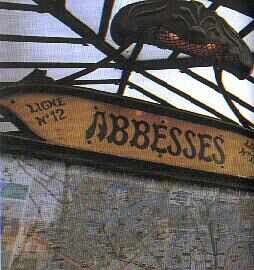
But let’s take the opportunity to have a brief historical review of the
starting period of the Parisian metro! We are in 1900! A fabulous invention,
this underground train, dividing the Parisians in two clans. To encourage the
population to use and to descend into these infernal depths, the architects
convey Hector Guimard the task to design aesthetic and inviting metro entrances.
He has a double problem: conciliate economic (for a reproduction in series) and
aesthetic considerations. So this genius of the Art Nouveau (the other one is
Victor Horta in Brussels) chooses metal and cast-iron and gets his inspiration
from the animal and vegetal world. He thinks about everything: he cares about
the comfort of the traveller by lighting the panels indicating the stations,
weather-boards, handrails, external glass porches or roofs in case of rain. The
station “Abbesses” is the deepest in Paris (30 meters)
At one side of the square you will notice the church Saint-Jean de Montmartre,
also called Saint-Jean des Briques. It is a remarkable edifice, because the use
of reinforced concrete in 1894 was a total architectural revolution. The church
can be visited at fixed dates: just take your info on the spot.
Rue Yvonne le Tac, at no 9 THE
MARTYRIUM. A chapel to remember the death of Saint-Denis. It’s in the crypt of
this church that Ignatius de Loyola created the order of the Jesuits!
Experienced mountain climbers, the RUE FOYATIER is something for you! Take
grappling irons, safety-clasps and mountaineer cords with you! The
cliff-staircase culminates at 225 steps! Luckily it is cut twice by a landing
where you can come back to your senses. A little advice for the less sporty
ones: the funicular brings you for a few francs, without any effort, to the same
destination.
Let’s just have another stop at the PLACE CHARLES DULLIN.A regal! Another one
of these small intact village squares like a movie “still image”. His main
building is the Theatre de l’Atelier, called before theatre de Montmartre
until the arrival of the genial actor Charles Dullin. From then on, Moliere and
Racine had to share the stage with Anouilh, Sagan, Ayme and foreign theatre
writers.
That’s it.
My tour came to an end. Of course you should go and walk at random, especially
shopping in the rue Lepic starting from the Place Blanche and climbing
lasciviously around the hillside. The lower part of the street, between Blanche
and rue des Abbesses, is an animated market. After your shopping, don't forget
to have a drink at no.12, the Lux Bar with a superb mural ceramic decoration of
1910, representing the Moulin Rouge.
Bibliography
Nouvelle
Histoire de Paris, ed.Hachette--Le Pieton de Paris, by L.P.Fargue, ed.Gallimard
-- Paris 19eme siecle, l'immeuble et la rue, by F.Loyer, ed.Hazan, 1994--
Montmartre, balades et decouvertes, by Vincent de Langlade, (own folders
1998),--Montmartre dans l'histoire de Paris, by E.Botteau ( Presse Cité,
1993)—Le 18th arrondissment, by Renaud Lefevre (ed.Nelle’s--)Paris aux cent
visages, Magazines, Les Eglises a paris, Mairie de Paris.-Jean Favier, Paris,
deux mille ans d’histoire, Jean Favier ed.Fayard.
|
