|
Montmartre Bateau Lavoir Wallace fountains Paris Site Home -What's New?-Feedback - About Jack-Travel/Art Links |
|
|
|
Starting Jacks walking tour (1) Cemetery- Moulin de la Galette (2) Passage avenue Junot, Villa Leandre (3) Impasse Girardon, Square Buisson, allee des Brouillards (4) Place Dalida, Musee du Vieux Montmartre (5) Vineyards Montmartre, Cabaret Le Lapin Agile (6) Cemetery Saint Vincent, The Paris Commune history(7) Cemetery Calvaire-Saint Pierre de Montmartre Espace Dali-Folie Sandrin (8) Wallace fountains Place Abbesses End of Montmartre visit 10)
Walking flea markets Malik, Vernaison and Paul Bert Walking flea markets,Valles, Serpette, Biron and Cambo
|
Paris-18th arr-Wallace fountains-Le Bateau Lavoir |
||
|
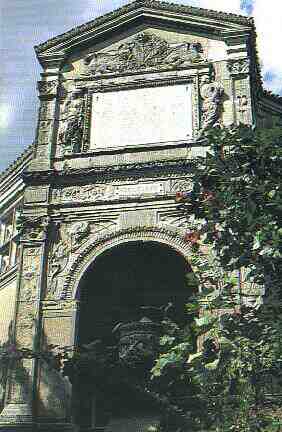
From the rue Poulbot enter the place J.B.CLEMENT where a Renaissance style fountain-reservoir replaced the dried up water sources of the butte.
It used to contain 125,000 litres and
elevated in the air it could contain 260,000 litres. A
cherry tree is planted in the middle to remind the Commune days. (Le
Temps des cerises). This song is a veritable revolutionary hymn disguised
in a common Ritornello. It evokes the offering of cherries by a young girl
during the events of the French Commune. Enter now the rue de la Mire where the
famous J.B.Clement, author of the song “Le Temps des Cerises” lived. The
small and narrow rue de la Mire reminds also that the meridian of Paris passes
exactly there. Now you have the RUE D’ORCHAMPT on your left, where Dalida
lived at no.11. Her house still attracts a lot of people but is closed for
visitors. This vast house, engaging and over-elaborated at the same time, looks
like its former proprietor, cosmopolite woman, complex but a real “fille de la
butte” without any “chi-chi”. Return to the rue Ravignan and at the end of
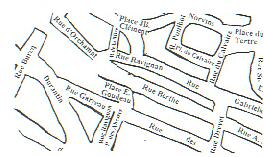
this one you come to the PLACE EMILE GOUDEAU, a very charming square with its
trees,
old-fashioned plasterwork and a Wallace fountain. A genuine post card!! Wallace?
Who was that? Sir Richard Wallace, immensely rich was an art amateur, fallen in
love with France and acted like a great philantrop. While his son fought in the
French army in 1870, he relieved the Parisians the best he could: ambulances to
help the wounded, offering after the war of two large public fountains PER
ARRONDISSMENT, like the drinking fountains in Great-Britain. His example was
imitated and soon there were Bibliography Nouvelle Histoire de Paris, ed.Hachette--Le Pieton de Paris, by L.P.Fargue,
ed.Gallimard -- Paris 19eme siecle, l'immeuble et la rue, by F.Loyer, ed.Hazan,
1994--Guide du Routard, 199 (ed.Hachette)--Montmartre, balades et decouvertes,
by Vincent de Langlade, (own folders 1998),--Montmartre dans l'histoire de
Paris, by E.Botteau ( Presse Cité, 1993)—Le 18th arrondissment, by Renaud
Lefevre (ed.Nelle’s)-Bateau Lavoir, la pepiniére de talents , by Benard
Lebutort. |
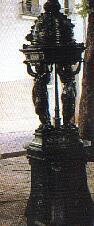
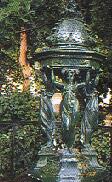 about 80 Wallace fountains all over Paris. Two
models: in green bronze. One had a caryatid type (four sculpted women supporting
a small dome. All have significance, Simplicity, Goodness, Sobriety, Charity).
The second model is a trimming, nailed to the wall, where tritons are playing.
There used to be at each fountain a tin mug but they all disappeared. Theft or
hygienic concern? I should choose the first option! At no.13 the most famous of
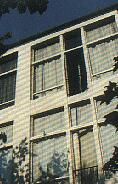
all Montmartre ateliers: "BATEAU LAVOIR" (first called La Maison du
Trappeur) where so many famous artists used to live. Around the turn of the
twentieth century about 20 painters had settled here
about 80 Wallace fountains all over Paris. Two
models: in green bronze. One had a caryatid type (four sculpted women supporting
a small dome. All have significance, Simplicity, Goodness, Sobriety, Charity).
The second model is a trimming, nailed to the wall, where tritons are playing.
There used to be at each fountain a tin mug but they all disappeared. Theft or
hygienic concern? I should choose the first option! At no.13 the most famous of
all Montmartre ateliers: "BATEAU LAVOIR" (first called La Maison du
Trappeur) where so many famous artists used to live. Around the turn of the
twentieth century about 20 painters had settled here forms, jostled the usual
techniques at such a level that his own
forms, jostled the usual
techniques at such a level that his own 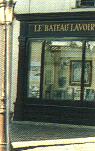 friends thought it was a practical joke.