|
If you want
to see something very special, you would never have discovered by yourself,
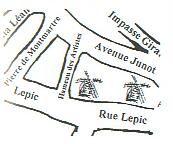
return at no.75, rue Lepic and try to enter the small door unless these new
damned electronic key locks will not lock it. It gives access to a terreplein, a
raised strip of the Hameau des Artistes (it connects the Lepic with the avnue
Junot). The place is very picturesque, with its houses built in an unexpected
architecture, large pavilions and ateliers hide behind dream gardens (beware,
picnic is forbidden, it's a private property). The surrealist painter, Max Ernst
used to live here.
But return again lower on the rue Lepic and enter a new adventure at no.65, by a
secret passage, this time certainly open, anonymous, followed by exactly 63
stairs. 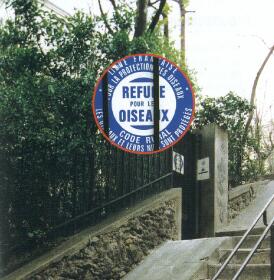 Trees,
last survivors of former scrub are still the home of numerous birds. Just in the
middle of the path, an enormous stone, popped out from nowhere blocks your
route, its presence puzzles you….Just in front a Directoire building of
unknown origin. Next to it a“ boulodrome” (where they play petanque or
boules) waiting for its clients. The about 20 trees you see are the last
remnants of the former Monmartre forest. They almost disappeared, victims of
real estate promoters, never short of ideas wanted to raze it all down and build
some imbecile parking lot. Luckily, the Montmartrois, always ready to save their
patrimony formed a committee! Their hard opposition of the inhabitants and the
support of a lot of artists, decided the promoters to let go. Like Jacques
Fabbri said:" One feels a little ridicule to fight over a few trees, but
it's life we defend!! Trees,
last survivors of former scrub are still the home of numerous birds. Just in the
middle of the path, an enormous stone, popped out from nowhere blocks your
route, its presence puzzles you….Just in front a Directoire building of
unknown origin. Next to it a“ boulodrome” (where they play petanque or
boules) waiting for its clients. The about 20 trees you see are the last
remnants of the former Monmartre forest. They almost disappeared, victims of
real estate promoters, never short of ideas wanted to raze it all down and build
some imbecile parking lot. Luckily, the Montmartrois, always ready to save their
patrimony formed a committee! Their hard opposition of the inhabitants and the
support of a lot of artists, decided the promoters to let go. Like Jacques
Fabbri said:" One feels a little ridicule to fight over a few trees, but
it's life we defend!!
So the mysterious stone still stands there, nobody knows where it comes from.
Maybe some asteroid? Notice that this scrub area often inspired Van Gogh.
We step out and are now 23, avenue Junot. Total changement! The scrub is
replaced by Montmartre houses. The avenue Junot is the Champs-Elysees of
Montmartre. The most expensive houses of the area. You'll never see much people
here. Make right away a left to discover this street, which destroyed almost all
the scrub (where a lot of painters had their home) of the butte when it was
built. Today a few nice samples of modern architecture and Art Deco of the
twenties. At no.25, “Villa Leandre”! Welcome to Chelsea or Kensington!
Created in 1926 this allotment has stunning Victorian allure and style. Podded,
husked, monstrous of peace and tranquillity, insolently covered with greenery,
this villa looks as it defies all epochs and gets fixed in an immutable
privileged instant. Max Ernst lived there for a while. So did Jean Marais and
Anouk Aimée.
Just in front of the exit (or
entrance) of the villa Leandre, observe at no.10 the nice facades of the
thirties of this hotel particulier.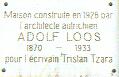 We come now to 30, avenue Junot. Built by the architect Adolf Loos in 1926 it
belonged to Tristan Tzara, a Dadaist poet. The architecture of Adolf Loos, a
pupil and founder of the Viennese Art deco style, expurgated the facade of any
ornament. Sobriety is the rule.
We come now to 30, avenue Junot. Built by the architect Adolf Loos in 1926 it
belonged to Tristan Tzara, a Dadaist poet. The architecture of Adolf Loos, a
pupil and founder of the Viennese Art deco style, expurgated the facade of any
ornament. Sobriety is the rule.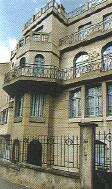 The theory of Loos was that the decorative effect had to be obtained by the
combination of different materials and not by working on these materials.
The theory of Loos was that the decorative effect had to be obtained by the
combination of different materials and not by working on these materials.
At no.13, the house of Poulbot. Poulbot? Of course, the street boy, frolic and
chaffer, everyone knows him! What we know less is that he wears the name of his
“spiritual father” Francisque Poulbot, a humorist and cartoonist who had a
lot of success. He initiated and developed a social structure for the poor kids
in his neighbourhood he liked to draw. Adopted Montmartre citizen from the heart
he built this house and never left the butte anymore.
The promenade continues in next article.
Bibliography
Vie
et histoire des arrondissements de Paris, ed.Hervas (1985-1988--Nouvelle
Histoire de Paris, ed.Hachette--Le Pieton de Paris, by L.P.Fargue, ed.Gallimard
--Guide du routard 1999, (ed.Hachette), Paris 19eme siecle, l'immeuble et la
rue, by F.Loyer, ed.Hazan, 1994, --Montmartre, balades et decouvertes, by
Vincent de Langlade, (own folders 1998), --Montmartre dans l'histoire de Paris,
by E.Botteau
(Presse Cité, 1993)—Le
18th arrondissment, by Renaud Lefevre(ed.Nelle’s)
|
