|
RUE LEPIC is a colourful
shopping street. Despite it looks
uninteresting at first sight, the passage Lepic at 16, rue Lepic, leads you to
delicious little houses the one more picturesque than the other.
Come back to the rue Lepic and enter the impasse Marie-Blanche through the rue
Constance. You are stunned. Is this
Paris? You feel more being in Disneyland!  You
are in front of a neo-gothic manor, without any equivalent in Paris! This
building, having been the propriety of the comte Charles de l‘Escalopier, a
bibliothecarian, had a very rich library in this house. This building of the 19th
century seems to jump out of a Walter Scott novel. It’s a part of a phenomena
we will see more in Montmartre: the “follies “of Montmartre. You
are in front of a neo-gothic manor, without any equivalent in Paris! This
building, having been the propriety of the comte Charles de l‘Escalopier, a
bibliothecarian, had a very rich library in this house. This building of the 19th
century seems to jump out of a Walter Scott novel. It’s a part of a phenomena
we will see more in Montmartre: the “follies “of Montmartre.
Return to rue Lepic again. At no.54 here is the first sign of the past presence
of artists on the butte Montmartre. Theo and Vincent Van Gogh lived at this
number. Keep a moment of emotion when you look up to the third floor. That’s
where Vincent lived with is brother.
Take the rue Caulaincourt, join the avenue Rachel and start the visit of the
CEMETERY OF MONTMARTRE .
Among the 15 cemeteries of Paris it is one of the most picturesque together with
Montparnasse and Pere Lachaise. Very special and certainly worth a visit, it
offers in fact in a reduced version, as much as his competitors, especially in
the delirious sculptures, sometimes of a very questionable taste! Try to find
the delirious or simply picturesque achievements like the replica of the Michel
Angelo Moses on the grave of banker Osiris. The mausoleum dedicated to Delphine
Fix (3rd division) is worth the detour also! But fortunately the cemetery is not only dedicated to this presumptuous
people without real taste but it is a genuine Pantheon housing the most
prestigious names: try to get a map to locate the tombs of Louis Jouvet, Ampere
(electricity), Adolphe Sax (inventor of the saxophone, a Belgian)
|
|
|
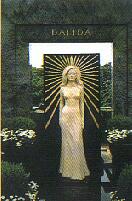
Dalida sculpture at her grave |
Degas, Alexandre Dumas (the
three musketeers)Hector Berlioz, Jacques Offenbach, Stendhal, Francois
Truffaut, Fragonard, Theophile Gauthier, Eugene Labiche, Degas, Sacha Guitry,
Poulbot, Greuze, Dalida and Heinrich Heine.
 |
|
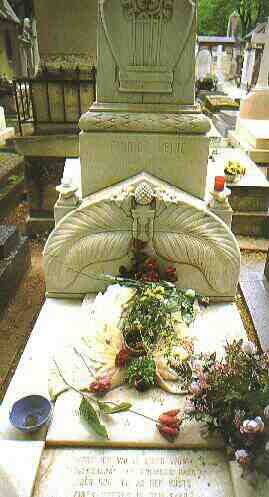
Tomb of Heinrich Heine |
Amateurs of funeral art don’t miss
the most remarkable sculptures classed by theme and you can’t miss the most
flourished tomb, the one of the singer Dalida (18th division) with a
large bust of her in front.
Join the rue Lepic again by the rue Joseph-de-Maistre and take the rue de
Tholoze arriving at rue Lepic just in a bend. Climb until no. 79 and the summit of the rue Tholoze will offer you a
splendid face-a face with the MOULIN DE LA GALETTE (corner rues Girardon and
Lepic), the last survivor of the great windmills of Montmartre dating from 1622.
The mechanism of the Moulin de la Galette braved the times and is still intact.
But the history of this Moulin becomes quite bloody during the invasion of Paris
in 1814 by the Prussian and Russian armies. According to legend, the four
brothers Debray defended the mill furiously but even the courage of these men
couldn’t help Napoleon. 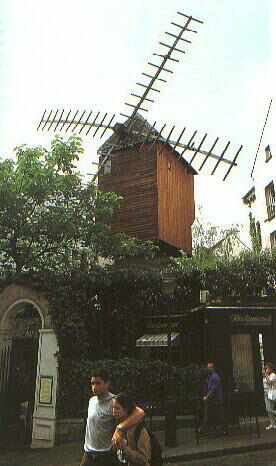 One of the brothers was even cut in four parts and
crucified on the mill’s wings! His
wife will, during the next night, took him of this quite unusual gallows and hid
him in a sac to bury him as a Christian in the Calvaire cemetery. A miniature
mill is mounted on the grave to perpetuate his memory forever. One of the brothers was even cut in four parts and
crucified on the mill’s wings! His
wife will, during the next night, took him of this quite unusual gallows and hid
him in a sac to bury him as a Christian in the Calvaire cemetery. A miniature
mill is mounted on the grave to perpetuate his memory forever.
The extension of the wine fields and the diminishing of the agriculture in
Montmartre signed the death warrant of the mill function of a lot of Montmartre
mills who had to close down but the Moulin de la Galette transformed in a
“guingette”, a tavern and a dance hall, to entertain the people. The
population increased to 36,000 inhabitants against 600 in 1806. Usual customers
of the Moulin were Toulouse-Lautrec (who came here to drink a salad-bowl of hot
wine, aromatised with cinnamon and to keep low company with the bad boys of
Montmartre), Van Gogh, Utrillo and Renoir” (see his wonderful oil “Bal au
Moulin de la Galette” in the musee d’Orsay)
Bibliography
-Vie
et histoire des arrondissements de Paris, ed.Hervas (1985-1988--Nouvelle
Histoire de Paris, ed.Hachette--Le Pieton de Paris, by L.P.Fargue, ed.Gallimard
--Guide du routard 1999, (ed.Hachette), Paris 19eme siecle, l'immeuble et la
rue, by F.Loyer, ed.Hazan, 1994, --Montmartre, balades et decouvertes, by
Vincent de Langlade, (own folders 1998), --Montmartre dans l'histoire de Paris,
by E.Botteau ( Presse Cité, 1993) –Une Journéeàau cimetière Montmartre
Vincent de Langlade (own folders)-Les Prussiens à Paris, by Jacques Lazarigue
(ed. Bonneton)
|
