|
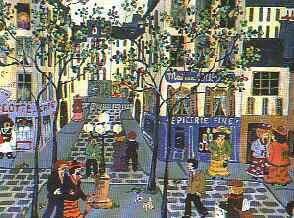
Roland
Dorgeles, author of different moving works about the Montmartre of his youth,
described the last “Parisian village” as he called it (the “Mecca of the
artist” like Francis Carco named it as follows: “Take a compass, put the
point on a Paris map between the Sacre Coeur and the Moulin de la Galette and
trace a circle from place Ravignan (today place Emile Goudeau) to the rue
Lamarck, from square Saint-Pierre to rue Caulaincourt and you have the
boundaries of a very tiny country….”
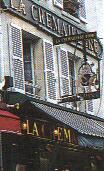
Montmartre, perched on a steep hill in the northern rim of Paris, is a legend in
itself.
Mountain of Mars, Mountain of Mercurius, Mountain of Martyrs, and all possible
etymologies have been tried by philologist and historians to the origin of this
area and its boundaries.
In fact is Montmartre the most divided part of Paris. Already under the leaves
of the trees on the square d’Anvers, in the 9th arr, this is
already Pigalle and Montmartre. The Montmartre of the boulevard de Rochechouart
with its sex shops has NOTHING in common with the peaceful rue des Saules and
the rue Saint-Vincent. The food barn –rue Lepic and rue de Abesses—of
Montmartre has nothing to do
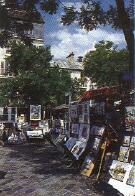 with
the Montmartre of the place du Tertre where fake painters and daubers set up
their easel and fool the millions of tourists. If one could say that Montmartre
is always crowded with tourists, surprisingly, a walk a few blocks away from the
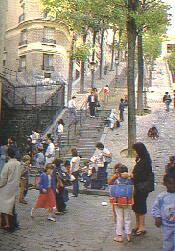
place du Tertre brings you to quiet streets where stairs tumble don to the city
below, quiet as the cats prowling about. with
the Montmartre of the place du Tertre where fake painters and daubers set up
their easel and fool the millions of tourists. If one could say that Montmartre
is always crowded with tourists, surprisingly, a walk a few blocks away from the
place du Tertre brings you to quiet streets where stairs tumble don to the city
below, quiet as the cats prowling about.
Beginning of 19th century, the " butte" Montmartre, let's call it from
now on Montmartre hill, was a hillock covered with orchards, vineyards, gentle
farmhouses and about 30 wind mills. When Montmartre was annexed to Paris in 186
it was only a small village, vegetable gardens
enhanced a few houses and the citizens raised and made their own wine.
But growing industrialisation put a lot of millers out of work but when it was
discovered that the underground had a lot of gyps, the millers became gyps
quarry workers and exploited the underground of the hill. The Place Blanche
(White) kept her name from that period. They dug numerous
 galleries, searching for good limestone in fact for plaster extraction with the
disastrous consequence that the Montmartre underground is very unstable today.
Some older Montmartrois assure you that one of these days the whole hill will
crash together as a “chateau de cartes”.
galleries, searching for good limestone in fact for plaster extraction with the
disastrous consequence that the Montmartre underground is very unstable today.
Some older Montmartrois assure you that one of these days the whole hill will
crash together as a “chateau de cartes”.
Many people moved suddenly to Montmartre in the 19th century because
of the destruction of half Paris (the poorer side) by the great urbanistic works
of Baron Haussman in Paris. A lot of workers and popular families settled down
on the hill. Rent was low and no taxes on wine. It was a good living there.
Thanks to its bucolic charm, Montmartre got quickly populated. Beginning of this
century the boheme of artists settled down. From 1880 to the new century
Montmartre had his highlight as anti-bourgeois bohemian area. Cabarets showed
anti establishment acts, shocking the bourgeoisie from the chic neighbourhood?
Even today you can still taste some of the anarchistic and libertarian tradition
of the area. Picasso also had his
stay from 1904 to 1912 in the “Bateau Lavoir”, a big but shaking baroque
building and painted here the most famous of all his works, the start of
cubism,"Les Demoiselles d'Avignon (13, place Emile Goudeau). A lot of other
celebrities lodged there: Matisse, Braque, Harry Baur, and so many others.
Renoir painted and lived in Montmartre, but it is Utrillo who succeeded the best
to represent the poetic and melancholic character of the Montmartre streets and
squares.
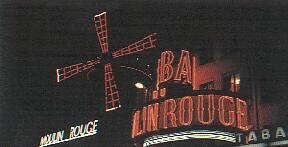 Without
forgetting Tououse-Lautrec, who immortalized the Moulin Rouge (created in 1889)
dancers and entertainers like Yvette Guilbert, Jane Avril, Valentin le Desosse,
La Goulue. But before WW I showed its teeth, the charm was over and the great
exodus to the new Mecca of artists, Montparnasse. Promoters had their hands free
now and turned a lot of old houses in the old Montmartre on the Butte into
concrete. The new, enriched bourgeoisie arrived!. Without
forgetting Tououse-Lautrec, who immortalized the Moulin Rouge (created in 1889)
dancers and entertainers like Yvette Guilbert, Jane Avril, Valentin le Desosse,
La Goulue. But before WW I showed its teeth, the charm was over and the great
exodus to the new Mecca of artists, Montparnasse. Promoters had their hands free
now and turned a lot of old houses in the old Montmartre on the Butte into
concrete. The new, enriched bourgeoisie arrived!.
But Pigalle and Blanche became an incredible melting-pot of vagrants, tramps,
prostitutes, a whole faun of fraudulent people mixed with the festal bourgeois
and tourists on the tours the apotheosis of shrill neon.
Bibliography
-Vie
et histoire des arrondissements de Paris, ed.Hervas (1985-1988--Nouvelle
Histoire de Paris, ed.Hachette--Le Pieton de Paris, by L.P.Fargue, ed.Gallimard
-Paris, 2000 d'histoire, by J.Favier, ed.Fayard 1997—Paris insolite, by Michel
Dansel, ed.Hachette, Naissance de Paris, by M.Fleury, ed.Imprimerie Nationale
1997-Guide du routard 1999, (ed.Hachette), Paris 19eme siecle, l'immeuble et la
rue, by F.Loyer, ed.Hazan, 1994, Montmartre, balades et decouvertes, by Vincent
de Langlade, (own folders 1998), Montmartre dans l'histoire de Paris, by
E.Botteau ( Presse Cité, 1993)
|
