|
A good piece of advice
before starting the landmark tour. Montmartre is not fit for cars, the
pedestrian is king.
There is a brand new funicular for those who rebuff the hill's stairs. Even if
Pigalle dies slowly due to years of imposture and hangmen of mentality of what's
called " having fun", even if he Place du Tertre is almost totally
sold to massive tourism, Montmartre continues to attract curiosity from the five
world continents. There must be a reason!! It is because one simple thing: the
hill, once you go off beaten path, reserves still charming surprises for
strollers and curious people. Old houses full of wrinkles, ivy covered
staggering walls, savage paths and little roads, sometimes lined with cherry
trees, appear at the right moment.
First that SACRE COEUR: an inevitable and enormous pastry sitting like on a
throne on top of the Butte Montmartre (and the most sold post card, it's to be
despaired about humanity! but “les gouts et les couleurs ne se discutent
pas!)). If the Parisians had to vote for the ugliest church in town, they would
designate the Sacre-Coeur. But this is not the opinion of the tourists!!! They
talk about a “fairy cathedral.
This church has always been the centre of a controversy between admirers and
heavy opponents. Beside the architectural dispute there is also political one.
The
basilica building must be seen as an expiation for the revolution of 1870, also
known as "La Commune" .They succeeded very well in this
perspective! A lot of people found the building a hideous one,and a lot of
political trouble stirred up when it was approved in 1879 by the French National Assembly
. Radical congressmen (Clemenceau)
denounced the destruction of the Montmartre site and the unaesthetism of the
edifice.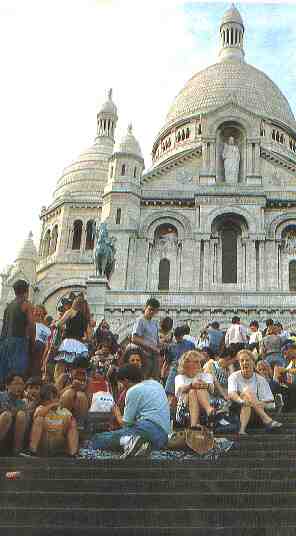
But where is the political controversy? Well, the building of the Sacre-Coeur is
seen as an act of Christian proselytism to point a finger to the
“free-thinkers” and degrade the Republic. After a contest the project was
given to a solemn, stately and conformist architect: Paul Abadie. It took until
1914 to finish the building. Style? Classico-Byzantino-Neo-romantico, everything
a melange.
However the interior is not very interesting (some of you will not agree, but
again: les gouts et les….) But, for the sportsmen and amateurs of nice views,
take the 237 steep and narrow steps climb into the Cupola (and pay for it). You
will enjoy an admirable circular panorama of Montmartre and Paris.
Incredible but true: did you know that since 110 years, men and women relay each
other 24/24 h to pray to expiate the sins of humanity? There are even beds to
rest between 2 rosaries, that’s at least what the Routard pretends.
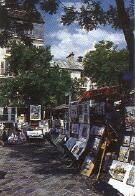
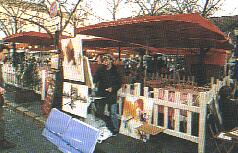
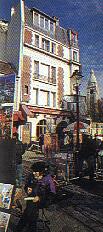
Another extremely popular tourist place and the biggest of all traps id the
PLACE DU TERTRE, already existing in the 14th century.
In the morning, at sunrise, you have the feeling of being on a village
marketplace far away from Paris. 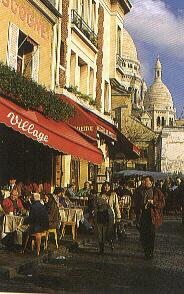 You
can have a quiet breakfast at one of the terraces. But when the tourist hoards
come in after ten and start to stampede the place it’s worse than Fifth Avenue
on Christmas shopping days! You have the feeling riding the Metro in rush hour.
Dozens of daubers offer you their “masterpieces”. You could die of an
overdose of daubs and bad paintings, (2 painters for a square meter, it's
regulated!); In fact it is more interesting to look at the tourists! But one can
like this animation, the colours, and the lights. With their red-white chequered
tablecloths, supposed to look authentic, the restaurants also try to attract
some victims. Better ignore them. You
can have a quiet breakfast at one of the terraces. But when the tourist hoards
come in after ten and start to stampede the place it’s worse than Fifth Avenue
on Christmas shopping days! You have the feeling riding the Metro in rush hour.
Dozens of daubers offer you their “masterpieces”. You could die of an
overdose of daubs and bad paintings, (2 painters for a square meter, it's
regulated!); In fact it is more interesting to look at the tourists! But one can
like this animation, the colours, and the lights. With their red-white chequered
tablecloths, supposed to look authentic, the restaurants also try to attract
some victims. Better ignore them.
Right behind the Sacre Coeur
is the CHURCH SAINT-PIERRE DE MONTMARTRE: with the church of St.Germain, it's
the oldest (1134), one of the cutest in Paris and the only remains of the abbey
of Montmartre, created by Louis le Gros in 1133. For me the jewel of Montmartre!
The façade is of the 18th, the choir of the 12th and the
nave of the 15th. Next to the church is an old Merovingian, romantic
cemetery, only open on November the first or with a special tour guide (like I
visited it).
Montmartre has to be
seen in an off beaten walk that will start in next article.
Bibliography
-Vie et histoire des arrondissements de
Paris, ed.Hervas (1985-1988--Nouvelle Histoire de Paris, ed.Hachette--Le Pieton
de Paris, by L.P.Fargue, ed.Gallimard -Paris, 2000 d'histoire, by J.Favier,
ed.Fayard 1997—Paris insolite, by Michel Dansel, ed.Hachette, Naissance de
Paris, by M.Fleury, ed.Imprimerie Nationale 1997-Guide du routard 1999,
(ed.Hachette), Paris 19eme siecle, l'immeuble et la rue, by F.Loyer, ed.Hazan,
1994, Montmartre, balades et decouvertes, by Vincent de Langlade, (own folders
1998), Montmartre dans l'histoire de Paris, by E.Botteau ( Presse Cité, 1993)
|