|
To close definitely my
series about this part of the 18th arrondissement let’s have a word
about PIGALLE.
Clichy and Pigalle are undoubtedly one of the best-known names all over the
world concerning Paris.
Pigalle has a very bad reputation and like an elephant’s skin, it is
inflexible: people are sure that the area is still frequented by some hoodlums,
bad boys. But you can believe me, since 1981-82, the real gangsters are a
rarity. There are still nice houses in the area of the boulevard de Clichy but
don’t expect extraordinary architectural discoveries. It’s more the building
homogeneity that is one of the best conserved of Paris. And the main attraction
of the area is its atmosphere……
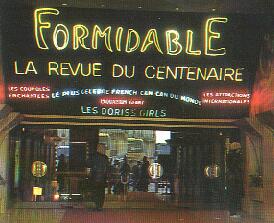 The
BOULEVARD DE CLICHY, extending from the rue des Martyrs until the place de
Clichy, reunites not only numerous sex-shops, cabarets, video-clubs, etc… but
at the north side ateliers reminding us that numerous artists had their
residence here. Degas at no.6,
Picasso at no. 11 (1930), Van Gogh, Bonnard, Toulouse-Lautrec, etc…Place
Pigalle housed the ateliers of Puvis de Chavannes, Hennier and others. It’s
the “Café d’Athenes” on the place Pigalle that was the meeting point of
the intellectuals during the great Pigalle era (Zola, Verlaine, Maupassant,
Monet, Degas). After a quarrel with the owner they changed for the facing “café
Pigalle”. Today the square is a Mecca for strip-joints. The
BOULEVARD DE CLICHY, extending from the rue des Martyrs until the place de
Clichy, reunites not only numerous sex-shops, cabarets, video-clubs, etc… but
at the north side ateliers reminding us that numerous artists had their
residence here. Degas at no.6,
Picasso at no. 11 (1930), Van Gogh, Bonnard, Toulouse-Lautrec, etc…Place
Pigalle housed the ateliers of Puvis de Chavannes, Hennier and others. It’s
the “Café d’Athenes” on the place Pigalle that was the meeting point of
the intellectuals during the great Pigalle era (Zola, Verlaine, Maupassant,
Monet, Degas). After a quarrel with the owner they changed for the facing “café
Pigalle”. Today the square is a Mecca for strip-joints.
The boulevard is lined with a long, long queue of tourist motor coaches. An
endless corridor of sexodromes, lingerie follies, " studios with all comfort at end of the alley" and tourist
traps with their porno pictures. Prices at the outside look cheap, but once you
go in you get the " bamboo stick hit" (means very, very expensive
extras!) All adjacent streets are also full of little light softened bars with
velvet curtains. If ever you’re a night hunter and are about 4 o'clock in the
morning in Pigalle you could maybe see a gathering of all what's miserable,
under drug influence and outlawed. I liked this quote in the guide du Routard,
expressing the misery that can be seen sometimes: "(quote):” If the
pleasure is faked, the misery is real: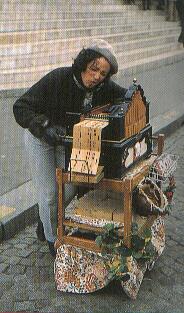 one is drugged, the other is drunk to
forget the day
coming. People prostitute themselves or beg to pay their room for the night.
Old, young, you have all kinds of homeless wandering and begging you for a
cigarette or whatever you can give(end of quote).
one is drugged, the other is drunk to
forget the day
coming. People prostitute themselves or beg to pay their room for the night.
Old, young, you have all kinds of homeless wandering and begging you for a
cigarette or whatever you can give(end of quote).
The future doesn’t' look good for Pigalle, the fear of AIDS cools the
amateurs.
PLACE BLANCHE owes its name to the white powder left on the street by the
endless wagons of flour and plaster transported from the butte of Montmartre.
But it became immortal thanks to the Moulin-Rouge.
Bibliography
Nouvelle
Histoire de Paris, ed.Hachette--Le Pieton de Paris, by L.P.Fargue, ed.Gallimard
-- Paris 19eme siecle, l'immeuble et la rue, by F.Loyer, ed.Hazan, 1994 - Guides
du Routard 1998-1999, ed.Hachette--Montmartre, balades et decouvertes, by
Vincent de Langlade, (own folders 1998),--Montmartre dans l'histoire de Paris,
by E.Botteau ( Presse Cité, 1993)—Le 18th arrondissment, by Renaud Lefevre (ed.Nelle’s--)Paris
aux cent visages, Magazines.-Jean Favier, Paris, deux mille ans d’histoire,
Jean Favier ed.Fayard
|
