|
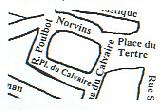
Descend the abrupt Passage
Cotton to the delicious passage Cottin. Come back on your steps to the CEMETERY
DU CALVAIRE. Only vestige that survived the ancient abbey of Dames de Montmartre,
the cemetery du Calvaire was the first even opened in Montmartre in 1688. It is
located next to apse of the church but t opens only one a year on Nov 1, day of
the dead. A certain Debray, professional miller, descending from a long dynasty
of millers was buried mast and his tomb wears a miniature windmill. The very
famous navigator de Bougainville threw his last anchor here like the sculptor
Piglet and many other tombs of former mayors and celebrities. ! Don’t miss the
antique roman columns: two of them are located at the entrance, against the
wall, the two others inside the church.
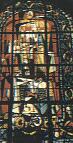 The
CHURCH OF SAINT PIERRE DE MONTMARTRE is the jewel of the butte, according to all
its inhabitants. It’s the oldest church in Montmartre and don’t let the
relatively recent façade (18th century) abuse you, the interior
vault, dates from the 12th century in the purest roman style and the
nave is from the 15th century. Don’t leave without having admired
the splendid glass stained window of Max Ingrand, The
CHURCH OF SAINT PIERRE DE MONTMARTRE is the jewel of the butte, according to all
its inhabitants. It’s the oldest church in Montmartre and don’t let the
relatively recent façade (18th century) abuse you, the interior
vault, dates from the 12th century in the purest roman style and the
nave is from the 15th century. Don’t leave without having admired
the splendid glass stained window of Max Ingrand,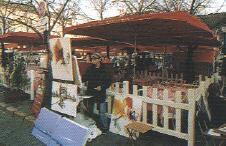 made in 1954.
We are practically on the place du Tertre, of which I promised neither to go
through nor to visit. If you want absolutely play the perfect tourist, be my
guest and mingle for a few minutes amidst this army of daubers, scribblers and
failures. We wait max 10 minutes and will continue…………
Ok, lets’ go. PLACE DU CALVAIRE: holds the record of the smallest square in
Paris. It is really a staircase “hard for the wretches and poor people”.
Here is the restaurant “Patachou”, built on an important slope that offers a
superb view from its garden side. Adorable little place du Calvaire. A useful hint: if you're in Paris
on the 14th of July or another big event, and you want to see the fireworks, the
best place is on the right side of the place du Calvaire.
We come now in the rue POULBOT. Quite special, carved into the Butte, at no.11
the ESPACE MONTMARTRE-DALI). Presenting lithography’s since 1990, sculptures,
serigraphy’s, all in all about 300 works (Montre Molle) for the unconditional
of Salvador Dali testifying the surrealist world of the master. Thanks to
special effects, his works are well presented: dramatic light effects and the
voice of the artist. An artist’s atelier is located on the top floor. Dali was
a part of the intellectual and political movement of the Butte with Tzara,
Picabia and Breton. In 1956, before the stunned tourists of the Place du Tertre,
he realized his famous "Don Quichote" with as a paint-brush, guess
what!!, a rhino horn. (anecdote related by the Routard).
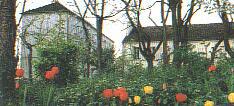 From
the rue Poulbot let’s enter the RUE NORVINS at no.22. This From
the rue Poulbot let’s enter the RUE NORVINS at no.22. This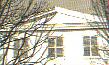 is the domain of the “FOLIE SANDRIN”, a countryside house that a mister
Sandrin refurbished in the 18th century. He closed the park until the
rue de l’Abreuvoir. Never the word “folly “ had its significance so clear
as it is here. First used as a psychiatric institute with a very good
reputation, (a court lady of Marie–Antoinette was a patient here) it housed
also Jacques Arago, who succeeded to write a book of 62 pages without using once
the letter “A”. Georges Perec succeeded recently to write one with the
letter “E”. The most known case of occupant of the folie Sandrin was the
poet Gerard de Nerval, sympathetic schizophrenic, walking with a live lobster on
a leash in the jardins du Luxembourg!
is the domain of the “FOLIE SANDRIN”, a countryside house that a mister
Sandrin refurbished in the 18th century. He closed the park until the
rue de l’Abreuvoir. Never the word “folly “ had its significance so clear
as it is here. First used as a psychiatric institute with a very good
reputation, (a court lady of Marie–Antoinette was a patient here) it housed
also Jacques Arago, who succeeded to write a book of 62 pages without using once
the letter “A”. Georges Perec succeeded recently to write one with the
letter “E”. The most known case of occupant of the folie Sandrin was the
poet Gerard de Nerval, sympathetic schizophrenic, walking with a live lobster on
a leash in the jardins du Luxembourg!
Today the folie Sandrin only house normal tenants paying a regular rent.
Bibliography
Nouvelle
Histoire de Paris, ed.Hachette--Le Pieton de Paris, by L.P.Fargue, ed.Gallimard
-- Paris 19eme siecle, l'immeuble et la rue, by F.Loyer, ed.Hazan, 1994--Guide
du Routard, 199 (ed.Hachette)--Montmartre, balades et decouvertes, by Vincent de
Langlade, (own folders 1998),--Montmartre dans l'histoire de Paris, by E.Botteau
( Presse Cité, 1993)—Le 18th arrondissment, by Renaud Lefevre (ed.Nelle’s)
|
