|
Did you ever hear of Marcel
Ayme? Anglo-Saxon readers probably not, but he is one of 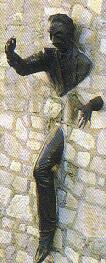 France’s greatest
writers. Native from the Jura mountain range, he is an adopted Montmartrois and
spent all his life on the butte, which inspired him most of his novels and
books. His novel
“Passe-Muraille” (the wall-passer) tells the story of a man suddenly having
this faculty to pass through walls. This mister Dutilleu finally, got stuck
forever in a wall during his x-th passage. Having suddenly lots his faculty he
could never reintegrate our world! That’s you’re going to see when you go
upwards the avenue Junot and reach the place Marcel-Ayme. Coming out of a wall
an incredible sculpture in relief from the French actor Jean Marais who proves
here he was also an excellent sculptor. France’s greatest
writers. Native from the Jura mountain range, he is an adopted Montmartrois and
spent all his life on the butte, which inspired him most of his novels and
books. His novel
“Passe-Muraille” (the wall-passer) tells the story of a man suddenly having
this faculty to pass through walls. This mister Dutilleu finally, got stuck
forever in a wall during his x-th passage. Having suddenly lots his faculty he
could never reintegrate our world! That’s you’re going to see when you go
upwards the avenue Junot and reach the place Marcel-Ayme. Coming out of a wall
an incredible sculpture in relief from the French actor Jean Marais who proves
here he was also an excellent sculptor.
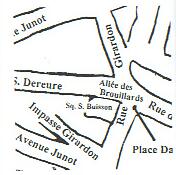
Come back a few steps and enter the IMPASSE GIRARDON. This impasse, once called
“impasse de la fontaine Saint-Denis’ used to lead to a miraculous fountain,
also called “Fontaine au Crane coupe” or “Fontaine aux Martyrs”.
 A
legend says that a young girl who would drink from the water of the fontaine
Saint-Denis will be faithful forever to her husband. This must be a legend
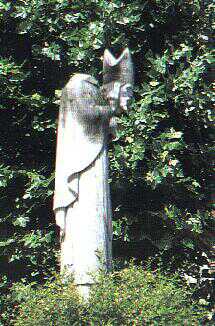
;-)…….Anyway, popular belief locates here the beheading of Saint-Denis.
Therefore this statue in the adjacent square SUZANNE-BUISSON . A
legend says that a young girl who would drink from the water of the fontaine
Saint-Denis will be faithful forever to her husband. This must be a legend
;-)…….Anyway, popular belief locates here the beheading of Saint-Denis.
Therefore this statue in the adjacent square SUZANNE-BUISSON . 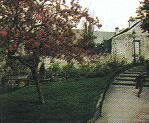 Art
Deco style, whole in terraces, very romantic in the evening, under the light of
the street lamps. Lined with a few pavilions, and the fountain in the middle. It
stopped running in the 19th century due to the anarchistic exploitation of the
gyps quarries on the butte.. Amidst such a peaceful tranquillity, the statue of
St.Denis loses his head looking at the petanque players. Saint-Denis is still
evoked today to cure headaches and delirious people. Art
Deco style, whole in terraces, very romantic in the evening, under the light of
the street lamps. Lined with a few pavilions, and the fountain in the middle. It
stopped running in the 19th century due to the anarchistic exploitation of the
gyps quarries on the butte.. Amidst such a peaceful tranquillity, the statue of
St.Denis loses his head looking at the petanque players. Saint-Denis is still
evoked today to cure headaches and delirious people.
Cross the square Suzanne-Buisson and enter the ALLEE DES BROUILLARDS. Very
narrow stairs, edged by a stone
balustrade and pavilions crumbling under the ivy. Behind the high walls, how
many secret gardens! The spot has so much charm! It's the ideal place to melt
down people in love. And there IT is, planted at the side of the
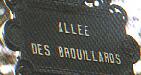 alley, with its
romantic looks, right of a 19th century novel, before our dazzled
eyes, and the seduction operates: what? The “CHATEAU DES BROUILLARDS” which
is in fact a "folie" (foolishness), build in the 18th century by a
rich aristocrat. At that time it was here absolute countryside and scrub. Soon,
other constructions were built next to it and made an ensemble in 1850. Gerard
de Nerval lived there in 1846. Renoir occupied once a pavilion at no. 8 of the
alley. Slowly the area is abandoned, squatted and grown over again by scrub. A
clever restoration in the 20th century saved it but it lots its one
so charming splendour (vegetable gardens, friendly small inside alleys). And
it’s survey, the simple fact that it still exists gives its admirers the same
emotion, the same wonder. alley, with its
romantic looks, right of a 19th century novel, before our dazzled
eyes, and the seduction operates: what? The “CHATEAU DES BROUILLARDS” which
is in fact a "folie" (foolishness), build in the 18th century by a
rich aristocrat. At that time it was here absolute countryside and scrub. Soon,
other constructions were built next to it and made an ensemble in 1850. Gerard
de Nerval lived there in 1846. Renoir occupied once a pavilion at no. 8 of the
alley. Slowly the area is abandoned, squatted and grown over again by scrub. A
clever restoration in the 20th century saved it but it lots its one
so charming splendour (vegetable gardens, friendly small inside alleys). And
it’s survey, the simple fact that it still exists gives its admirers the same
emotion, the same wonder.
Bibliography
Vie
et histoire des arrondissements de Paris, ed.Hervas (1985-1988--Nouvelle
Histoire de Paris, ed.Hachette--Le Pieton de Paris, by L.P.Fargue, ed.Gallimard
-- Paris 19eme siecle, l'immeuble et la
rue, by F.Loyer, ed.Hazan, 1994, --Montmartre, balades et decouvertes, by
Vincent de Langlade, (own folders 1998),--Guides du Routard 1999, (Hachette)--Montmartre
dans l'histoire de Paris, by E.Botteau ( Presse Cité, 1993)—Le
18th arrondissment, by Renaud Lefevre(ed.Nelle’s)
|
