|
The modest CEMETERY OF
SAINT VINCENT is at the other side on an elevated sidewalk, with iron ramp. It
is accessible through the rue Lucien Gaulard and looks out upon the place
Constantin Pecqueur. This cemetery, opened in 1831 will be ousted, for reasons
of total occupancy by the cemetery of Saint-Ouen. Let’s name, out of the 920
graves, the best known like Roland Dorgeles, Eugene Boudin (the painter),
Steinlein, Utrillo and Marcel Ayme.
If you go now to the rue du Mont-Cenis you’ll pass the SQUARE SAINT VINCENT,
authentic original savage garden where a panel at the entrance says: "Don't
be surprised by the aspect of this garden. Since 1985 we let the vegetation
evolve freely." Open only on Monday and Friday afternoon, weather
permitting No tourist here. Who comes now to see an abandoned garden? The opium
poppy grows together with the white nettle, water spiders are having great fun
(arachnophobias, beware!!) and read the very instructive panels (with a
dictionary please;-)
After the rue St.Vincent, take the rue du Mont-Cenis. To join that street you
have to stumble down (slowly) some stair flights. Beware, it’s steep and
cardiac do it very slowly.
At no.14 rue du Mont-Cenis Berlioz lived with his first wife. He divorced,
remarried with singer and his first wife was buried in the Saint Vincent
cemetery. When his second wife died she was put to earth in the Montmartre
cemetery. Then he decided to move his first wife also to the Montmartre cemetery
and you know why? To rest, when the ultimo moment would come, between his two
wives. Isn’t that post-mortem bigamy? ;-)
 |
|
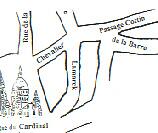
Rue du Chevalier de
la Barre
|
Come back now on your
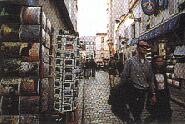
steps and after a monstrous water tower join the rue du CHEVALIER DE LA BARRE.
Here begins the sector, dedicated to cafes and galleries, set in ancient houses.
This chevalier de la Barre, aristocrat of the 18th century, committed an act of
sacrilege by refusing to salute a religious procession. Legend pretends that he
said: “God and me we know each other of course, but we don’t greet each
other” He was decapitated and burnt at the stake. That’s why in the 19yth
century the commune of Montmartre decided to name two streets (rue des Rosiers
and rue Fontenelle) after his name.
The outline of the street is quite anarchical. Starts as a street, transforms
into stairs, and finally becomes a pedestrian path. The area, at night is very,
very romantic with the pale halo of the street lamps. At no.55-57 the pace is
supposed to have had a Mercurius temple in roman times and that the four marble
columns of Saint-Pierre-de-Montmartre come from here. At no.40 the theatre
writer Courteline used to live, one of the rare born in Montmartre. Historically
it’s from this street that the famous uprising in 1870 known as the “Paris
Commune” started with the shooting of two officers of the regular army. The
story is too long to tell but you have to know that the revolutionaries fight
bloody battles, a genuine civil war lasting almost three months. As a backstage
decor, Paris in flames, under siege and 64,000 people dying of cold and
deprivation, sickness, typhoid and other jolly adventures. The Assemblee
Nationale decided to choose Versailles and not Paris as capital! That was the
drop too much! Thiers, who was the leader of the hated government, wanted to
take back the 227 canons and rifles left in Montmartre. Bad idea, he was
promptly sent away. All opponents reunited in the “Commune” but Thiers sent
his troops to fight the revolutionaries. During two months, the two camps acted
like savages: executions without any trial, hostage murders. On May 21 the
“bloody week of Paris “ started an ending with a burning Paris and the
capitulation of the “Commune”. Repression was terrible!! All “communards
will be shot at the Pere Lachaise the still existing “mur des féderés”.
Final balance: 17,000 to 25, 000 dead, 17, 000 to 35, 000 executed and more than
4, 000 exiled to New Caledonia. Thiers was the butcher, Clemenceau, was the
moderator who put an end to all this killings.
What remains today of this period? A song: “Le Temps des cerises” which
innocence is related to the posterity of this painful episode. A monument:
“Victimes de la Revolution”, evoking the “bloody week” at the Pere
Lachaise. In the 15th arr an alley and a miniature square is named after butcher
Thiers, and Gambetta received a square, a passage, and a metro station.In next
article we’ll visit finally this rue Chevalier de la Barre and have a few
words about the Basilique du Sacre Cœur.
Bibliography
Nouvelle
Histoire de Paris, ed.Hachette--Le Pieton de Paris, by L.P.Fargue, ed.Gallimard
-- Paris 19eme siecle, l'immeuble et la rue, by F.Loyer, ed.Hazan, 1994--Guide
du Routard, 199 (ed.Hachette)--Montmartre, balades et decouvertes, by Vincent de
Langlade, (own folders 1998),--Montmartre dans l'histoire de Paris, by E.Botteau
( Presse Cité, 1993)—Le 18th arrondissment, by Renaud Lefevre (ed.Nelle’s)
–La Commune, la marque d’une infamie », by J.Lahaiture (Presses univ
1986)
|
