|
Go and take a little city
guide at the Tourist office. One of the first buildings you encounter entering
Saint-Raphael along the coast road is the big white centre of Thalassothérapie
(seawater cures). Next to it its modern Palais des Congrès and the serried
ranks of the new yacht harbour. A little further, on the boulevard du Général
de Gaulle and the Promenade de Lattre de Tassigny, are the luxury shops and the
handful of turn-of-the-century hotels and blocks which lend the town its air of
a little Cannes. Curlicued Art Nouveau balconies, the moulding painted pistachio
and 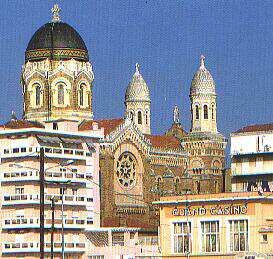 cream,
look out over. Now comes the Casino, in front of the dome of the late 19th
century Notre Dame de la Victoire the tall palms which line the raised
promenade. The so-called port in front of the casino is another construction of
the late 1800. Home to a small fishing fleet, a number of pleasure craft and the
regular ferry service between Saint-Raphael and Saint-Tropez (50 minutes
journey, the fastest way to get to Saint-Tropez in the summer) The “fishing
boats “ daily catch is on sale between 7.30 and midday in the wood-beamed fish
market on the place Ortolan. cream,
look out over. Now comes the Casino, in front of the dome of the late 19th
century Notre Dame de la Victoire the tall palms which line the raised
promenade. The so-called port in front of the casino is another construction of
the late 1800. Home to a small fishing fleet, a number of pleasure craft and the
regular ferry service between Saint-Raphael and Saint-Tropez (50 minutes
journey, the fastest way to get to Saint-Tropez in the summer) The “fishing
boats “ daily catch is on sale between 7.30 and midday in the wood-beamed fish
market on the place Ortolan.
The Cours Jean-Bart, running along two sides of the square port basin is the
night time centre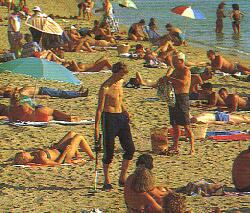 for strolling and sitting at café terraces consuming beers, lurid ice-cream
confections and cocktails. During high season a lot of peddlers, street
performers. Saint-Raphael is not a town of monuments. Traces of it’s Roman
past are restricted to a substantial collection of amphora, a superb
intact Hermes mosaic (considered as a world treasure), in the quite poor
MUSEE ARCHEOLOGIQUE.
for strolling and sitting at café terraces consuming beers, lurid ice-cream
confections and cocktails. During high season a lot of peddlers, street
performers. Saint-Raphael is not a town of monuments. Traces of it’s Roman
past are restricted to a substantial collection of amphora, a superb
intact Hermes mosaic (considered as a world treasure), in the quite poor
MUSEE ARCHEOLOGIQUE.
In the pretty but miniscule old town, nestled behind the old port, the 12th
century the eglise Saint-Raphael provides a link with the period of the Knights
Templar.
Notice that the leafy hillside suburbs of the north and east side of town centre
are the Edwardian-Provencal villas surrounded by beautiful gardens built for the
early-moneyed English settlers. Particularly concentrated in the suburb of
VALESCURE.
If present-day signs of Saint-Raphael’s medieval past are limited, and Roman
past almost non-existent, the reverse is true of FREJUS. It retains extensive
remains from the period that it was second only to Marseille in size and
importance as a Roman military port. Today it has responded to the demands of
our century tourism by acquiring two offshoots radically different in style from
the old town, and both closer to Saint-Raphael.
But its Roman remains are not less interesting for being dispersed for
throughout town. The enclosed remains of the AMPHITHEATRE or ARENAS dating 2nd
century could house 10.000 spectators. Half resting against a grass knoll it has
suffered of centuries of stone looting and less spectacular than the ones of
Arles and Nimes. The theatre is partly destroyed but serves today in the low
remaining section, with scaffolding benches as "plaza de toros" and a
stage for famous rock concerts. Major Roman remains include the base of the
western citadel known as the Butte Saint-Antoine, the Porte d’Orée, the
famous aqueduct which once supplied the whole city with running water (located
outside the porte de Rome).
The old area of Frejus has a considerable charm. This is due to its  handsome architecture and its slightly elevated position.
At the centre of old town is the QUARTIER EPISCOPAL in the rue de Fleury (Place
Fermigé). Compact, with lots of shops, pedestrian streets and, in the
summer, lots and lots of people. The CATHEDRALE SAINT ETIENNE, in the very
center, is built of lovely old stone and is set in a pretty square. The entrance
to the cloisters is inside the Cathedral entrance and has to be visited with an
obligatory guided and paying visit. This remarkable tour will lead you to a 12th
century, double naved church built on the ruins of a Roman temple.
Next, the small stone BAPTISTERY, one of the oldest in France, dating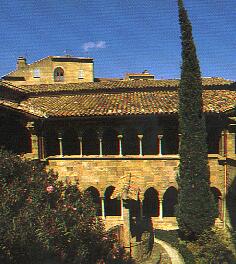 end 4th century! With its lovely two storied CLOISTER, peaceful and
adorable. Certain columns come from the Roman theatre stage. Painted
wooden ceiling evoking the Apocalypse and 1,200 little square painted wooden
tile. Double stairs also build with theatre tiers. Visits to the
baptistery and cloister must also be conducted, and are worth waiting for, as
both are fascinating.
end 4th century! With its lovely two storied CLOISTER, peaceful and
adorable. Certain columns come from the Roman theatre stage. Painted
wooden ceiling evoking the Apocalypse and 1,200 little square painted wooden
tile. Double stairs also build with theatre tiers. Visits to the
baptistery and cloister must also be conducted, and are worth waiting for, as
both are fascinating.
In Frejus they say often:" You can't dig in this city without finding a
Roman".
Notice that the centre d'Art moderne is totally uninteresting.
Bibliography:
John Pemble, "the
Mediterranean Passion, Victorians and Edwardians in the South", (Oxford
University Press 1988), Mary Blume, "Cote d'Azur. Inventing the French
Riviera" (Thames and Hudson, London 1982), Stephen Liégeard, “La Cote d’Azur”
(Ed.Serre, Nice 1988 a reprint), “La Provence des origines à l’an mil, by
P.A. Fevrier (ed.Ouest-France 1989), Dictionnaire de le France médiévale”,
by Jean Favier (Fayard , Paris 1993), « Roman remains of southern
France », by James Bromwich (Routledge London 1993)
|