|
From Nice to Menton
Nice
From Nice to
Menton-an itinerary
Villefranche-sur
mer
Saint-Jean-Cap
Ferrat
Beaulieu-Villa
Kerylos
Eze
perched village
Monaco
La
Turbie
Roquebrune-Cap Saint-Martin
Menton
From Nice to
Saint-Tropez
Cagnes-sur-Mer
Saint Paul de Vence
Vence-Matisse
chapel-City
Tourettes-Gorges
du
Loup-Gourdon
Grasse
Cabris and Valbonne
(anecdotes!)
Biot
Antibes
|
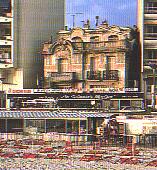 Let’s
continue to JUAN LES PINS where the beach residents inhale together the fresh
ocean air and the fresh gasoil fumes sitting on the narrow beach stripe
being separated from the asphalt road by a stoop and a few palm trees.
Everything here is untidy and disorderly and certainly less “chic”. We try
to get the soonest possible through the traffic. Let’s
continue to JUAN LES PINS where the beach residents inhale together the fresh
ocean air and the fresh gasoil fumes sitting on the narrow beach stripe
being separated from the asphalt road by a stoop and a few palm trees.
Everything here is untidy and disorderly and certainly less “chic”. We try
to get the soonest possible through the traffic.
The story of Juan les Pins starts only in the thirties. It used to be a pine
tree forest continuing until the sea and was in fact invented as seaside
resort by the American multimillionaire Frank Jay Gould, the man who gave his
second wife 5 automobiles as a present.
 |
|
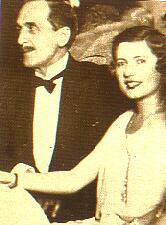
F.Jay Gould and wife |
Frank was the son of the railway tycoon
Jay Gould also called the “scoundrel baron”. He invested money in Cannes and
Nice casinos and built there his own hotels. In Juan les Pins the “Eden Beach
casino” and the “Hotel Provencal”. They came in the news by the fact they
had some mad novelties: every room had its own private bathroom and the guest
found a fresh new soap when they moved in the room. At the end of the twenties
Juan les Pins was already a very visited and very noisy bathing resort. So it
was certainly not the ideal dream place for that other kind of Americans: the
artists and would be artists, who had heard that everything was much cheaper in
France as in the States.
 |
|
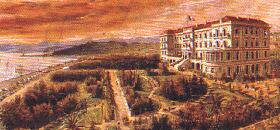
Juan les Pins-Grand Hotel 19th
century |
Sara and Gerald Murphy were one of the first of this
artistic migration, even if they were certainly not poor, on the contrary. In
1921 they first go to Paris where they discover the works of Picasso and Braque.
They will move on later to cap d’Antibes (see my articles about cap
d’Antibes).
Today Juan les Pins attracts mass tourism. In the summer there are many
festivals of which the prestigious “Jazz Festival of Juan-les-Pins”. Ella
Fitzgerald, Fats Domino, Lionel Hampton....
Continuing along the sea we pass GOLFE JUAN where a small monument reminds that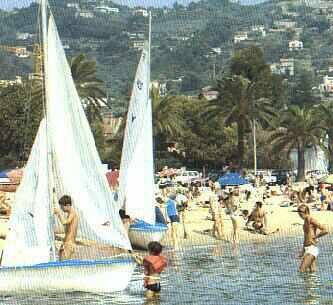 Napoleon disembarked on March first 1814 when he escaped
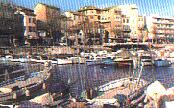 from
his banishment in Elba. A mosaic monument with the inscription under the two
eagles: “Ici débarqua Napoleon en 1815.” He landed with his boat
“L’Inconstant” and started the “100 days” until his defeat in
Waterloo. At the other side of the monument you can see a plaque:” Ici
commence la route Napoleon”, the road he followed to return to Paris, and
which is a very frequented touristy route nowadays. from
his banishment in Elba. A mosaic monument with the inscription under the two
eagles: “Ici débarqua Napoleon en 1815.” He landed with his boat
“L’Inconstant” and started the “100 days” until his defeat in
Waterloo. At the other side of the monument you can see a plaque:” Ici
commence la route Napoleon”, the road he followed to return to Paris, and
which is a very frequented touristy route nowadays.
The port of Golfe-Juan is packed with luxurious yachts that could never been
earned honestly....what a bad tongue I am ;-)
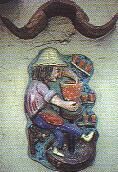 Via
the avenue de la Gare we can climb up to VALLAURIS, the ancient “Vallis
Aurea” (Golden Valley) now an important pottery centre, already since
Antiquity. Picasso settled down here in 1946 and gave pottery a second youth, by
making a craftsmanship with alimentary purposes into a real decorative art. He
worked in the ceramics manufactory. “Madoura”, attracted many artists and
tourists and painted here works like “Mass murder in Korea” (1951). Today
more than 200 "maitres potiers" work there with the traditional
techniques. Via
the avenue de la Gare we can climb up to VALLAURIS, the ancient “Vallis
Aurea” (Golden Valley) now an important pottery centre, already since
Antiquity. Picasso settled down here in 1946 and gave pottery a second youth, by
making a craftsmanship with alimentary purposes into a real decorative art. He
worked in the ceramics manufactory. “Madoura”, attracted many artists and
tourists and painted here works like “Mass murder in Korea” (1951). Today
more than 200 "maitres potiers" work there with the traditional
techniques.
But, but, besides pottery (and there is pottery ....and pottery, the worst and
the best live here together) and besides a few restaurants who deserve that name,
Vallauris is of very little touristy interest. Older residents remember how
sweet life used to be here but it changed a lot during the last 15 years. And not in the better way. Too much commercialised!
Numerous
shops of ceramics but don't be too enthusiastic. Usually it is worthless junk, a lot of
horrors but sometimes you stumble upon something worthy. The best are to
find at Madoura, who sells copies of Picasso gravures.
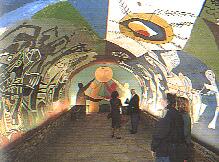
In 1951 the municipality proposed Picasso to decorate the chapel of the priory of
Vallauris.
 |
|
Guerre et Paix in the chapel |
What is now the MUSEE
NATIONAL “Guerre et Paix”? Nothing more than an old Provencal chapel where
he realized in 1952 an immense fresco "Guerre et Paix", in a record
time. War is represented by the coffin, hideous people, animals and
horses trampling books, symbol of
civilization. On the shield of a warrior, a dove, symbol of peace and a lance in
the shape of a balance, symbolizing Justice. 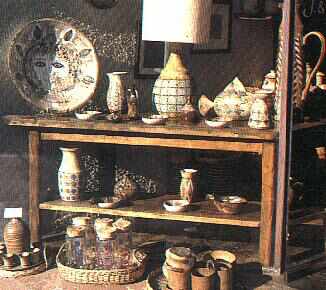 Dancing
people, joyful scenes enhance the opposite wall with a message of hope, let's
all fraternize, any race, any religion. Picasso painted it in a record tempo , a
normal house painter would need the same time to just paint a house! Dancing
people, joyful scenes enhance the opposite wall with a message of hope, let's
all fraternize, any race, any religion. Picasso painted it in a record tempo , a
normal house painter would need the same time to just paint a house!
Anyway the work was
heavily criticized since the sentiments where certainly not leftist at the time.
In 1955 he left Vallauris for Cannes, then Mougins but Vallauris still kept a
little space in his heart, however when municipality organized a
celebration for his 90 years, but he refused to come, saying: "I'd like to see
your spectacle, but I don't want to be your spectacle!”. He watched the whole
thing at home, on TV!( dixit the Routard)
Next to the museum there is another museum: MUSEE DE LA CERAMIQUE (Magnelli
museum) with paintings Magnelli on the second floor, a painter I admire a lot.
 |
|
Homme au Mouton |
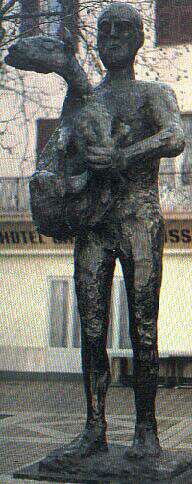
On the central square, place Paul Isnard, stands the Picasso statue "L'HOMME
AU MOUTON” (Man with sheep), a symbol of hope, made during WWII.
How pottery was made, from the start of the final product and a reconstitution
of an old pottery atelier is to see In the MUSEE DE LA POTERIE. .
Bibliography
Mary Blume, "Cote
d'Azur. Inventing the French Riviera" (Thames and Hudson, London 1982)
Stephen Liegeard, "La Cote d'Azur (Ed.Serre, Nice 1988), Guide du Routard
1998-99, Patrick Howarth, “When the Riviera was ours” (Century, London 1977,
“Greek Settlements on the Medterranean”, essay by J.Moss, “Antibes la
belle “, by Jean Centurion (ed. Nice
publ. 1991), “Picasso après le guerre”, by.J.Bornet (ed.Litard, Paris 1996,
“Ceramiques à la Cote d’Azur”, J.Foulques and B.Borderie (Ed. OeuvresArt
1998)
|
From Nice to Saint-Tropez (suite)
Cap
d'Antibes
Juan les
Pins-Golfe-Juan-Vallauris
Cannes
Iles
de Lerins
La
Napoule and Henry Clews
Esterel
cornice to Frejus
Frejus
Sainte Maxime to Port Grimaud
Old Grimaud and Cogolin
Saint-Tropez
From Saint Tropez to Cassis
Ramatuelle-Gassin-Croix
Valmer-Cavalaire
sur mer
Le
Lavandou-Bormes les Mimosas
Hyères
Island of
Porquerolles
Island of Port Cros - Ile du
Levant
Toulon
From Toulon to
Sanary-sur-Mer
Bandol
and island of Bendor
La
Ciotat and route des Cretes
Cassis and the calanques
|