La Turbie-Cote d'Azur Site Home - What's New? -Feedback - About Jack- Travel/Art Links

Cote d'Azur
|
La Turbie-Cote d'Azur Site Home - What's New? -Feedback - About Jack- Travel/Art Links |
|
|
|
Cote d'Azur |
|
COTE D'AZUR-La Turbie-Trophée des Alpes |
|
From Nice to Menton From Nice to From Nice to Saint-Tropez Tourettes-Gorges
du |
We leave Monaco and take the same ay back, the N 7, moyenne corniche, and follow it for a short while until we see at our right, the D 37, a very narrow road. This road will lead us through impressive hairpin bends and “wild screen” panoramas over the sea towards La Turbie. If ever you arrive on a Sunday, be prepared to experience one of the most beautiful located markets of Provence. The stalls run all along main street until the extreme end of the cliff of the corniche, a balcony of over 500 meters above sea level. Monaco is at our feet, we look from Cap Martin in the east unto Cap Ferrat in the west. What a difference in atmosphere from the mundane ambience of Monaco! The village itself is a living village, despite its open-air museum like medieval houses and streets. It grew from the 11th century into a small community and today you can still see intact walls and portals of the 12th and 13th century in one of the most wonderful sights of the Cote d'Azur . The town is small , built in a quarter circle with two surviving town gates. Wander a while in the old streets, vaults, narrow streets with old buildings from the 11th and 13th century ,passages where the medieval, the classic and the baroque skirt each other like the rue Comte-de-Cessole and the medieval baroque church Saint-Michel l’Archange (18th century). Built from stone from the Trophée des Alpes, , it has attractive bands of coloured tiles on its cupola. Beautiful frescos and paintings from the La Brea School.
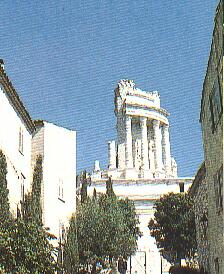
“Turbie” is probably a word corruption of the Roman “Tropaia Augusti” .The place, considered as very strategic for the Roman was taken after fierce battles with local population, regrouped in 45 Alpine tribes who had been attacking Roman Gaul. When they finally reduced the inhabitants into slavery, the Roman senate decided in build a “trophy to commemorate this victory”. The trophy was built between 13 and 5 B.C. with an original structure of 50 meters high, with a statue of emperor Augustus at the top. and, even now, 35 meters are still standing after 2,000 years. . The place chosen for this construction is at the foot of mount Agel and a strategic know of the Via Aurelia. Thousands of the imprisoned Ligurians and Celts worked as slaves to build the monument. Notice the quality of the friezes, much better conserved than the ones at Glanum and certainly better than in Carpentras. This here is a masterwork of roman building art and it offers also an unforgettable view on the Riviera. When the Roman Empire collapses in 476, La Turbie becomes the target of destructions for centuries. Even the monks of Saint-Honorat added their piece of a cent about the “pagan symbol” of the Trophy and demanded its destruction. Used as a stone quarry in the middle ages, to build houses and the village church it was later transformed into an impressive fortress, dismantled by Louis XIV. In 1705 the French blew up what remained but it is thanks to the billionaire Singer that it was restored. Believe it or not, the king of the sewing machine had a villa in the neighbourhood in the shape of a sewing machine!
A stuffy museum leans against the
Trophy, open all day but take please into consideration that the guard takes his
lunch at noon, taking with him the key opening a small barrier that leads via a
stone staircase upon the top of the Trophy. Lunch time can vary from one to two
hours, you never know ;-). Bibliography:
Mary Blume, "Cote d'Azur. Inventing the French Riviera" (Thames and
Hudson, London 1982) Stephen Liegeard, "La Cote d'Azur (Ed.Serre, Nice
1988), Patrick Howarth, “When the Riviera was ours” (Century, London 1977),
Michel de la Torre, Alpes-Maritimes 06 (ed.Nathan, later
Deslogis-Lacoste)-“Les Cent Jours de Napoleon”, by P.Gaxotte, ed.Albin
Michel |
From Nice to Saint-Tropez (suite) Juan les From Saint Tropez to Cassis Ramatuelle-Gassin-Croix Valmer-Cavalaire sur mer Le Lavandou-Bormes les Mimosas Island of Port Cros - Ile du Levant |