|
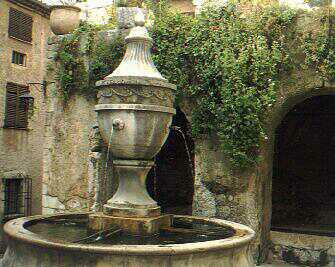 From Cagnes to SAINT-PAUL DE
VENCE it’s only a very short ride. This
small city was chosen in the 16th century by François 1er to be
fortified as a fortress along the Var, at that time being the border with Savoie.
He walled the city after tearing down more than 600 houses, later rebuilt in the
valley of the Loup and called now La Colle sur Loup. From Cagnes to SAINT-PAUL DE
VENCE it’s only a very short ride. This
small city was chosen in the 16th century by François 1er to be
fortified as a fortress along the Var, at that time being the border with Savoie.
He walled the city after tearing down more than 600 houses, later rebuilt in the
valley of the Loup and called now La Colle sur Loup.
The nicely polished and cleaned Saint-Paul is a perfect appearance of a small
medieval mountain city. The objection is that it misses a normal operating
society. In high season you can’t walk in the packed and overcrowded streets
along the fake art galleries and souvenir shops. Out of season you don’t see a
cat! Not even inhabitants.
Let's face it: it is one of the region's main tourist spots and you will have
plenty of time to admire the St. Paul fortifications if you enter the area
during its daily traffic jams which extends all the way down the D 36.
Built in 1536, these ramparts remained unbroken.
Imagine that in the 30's this village was an unknown, lost, dirty and
impoverished place, only visited and inhabited by a few painters, nobody in the
world having ever heard of them. But slowly, tourist industry discovered the gem
(not so gem anymore), and started to besiege by coach parties which invade its
tiny streets. I advise you (if possible) to arrive
early, because parking is always a problem.
 |
|
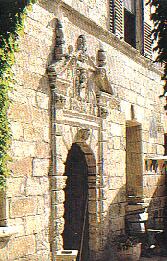
Entrance of La Colombe d'Or |
But if you cannot do otherwise,
leave your car outside the town : the café de la lace, just outside the main
north gate is a good place to stop for coffee and watch a"boules"
game.
But let's have a quick view about St. Paul's best known spot: the hotel-restaurant “LA COLOMBE D’OR”.
The fame of this historical establishment started between the two world wars.
Originally a little café with a simple restaurant, opened by the peasant couple
Roux, their son and his wife Titine started to make changments. It was then
called “Café-restaurant Robinson”. Saturday night and Sunday noon there was
dancing at the sound of a mechanical piano. Soon painters came to this joyful
and amusing place, taking even the tram from Vence to the café. Their names
were: Soutine, Signac, Dufy, Derain, Bonnard, Utrillo, Vlaminck and Modigliani.
Later on Braque, Picasso, Fernand Leger and Miro joined the party. In 1932 Paul
Roux rebaptized the place “La Colombe d’Or”. Matisse became a regular
customer too. Then the Colombe is discovered by the motion pictures world. In
1941 Jacques Prevert arrives, with his eternal cigarette between his lips,
followed by Marcel Carné, Joseph Kosma, Marc Allegret, H.G.Clouzot, Yves
Montand and Simone Signoret who have their wedding party in the Colombe. Finally
whole Hollywood appears when travelling on the Cote.
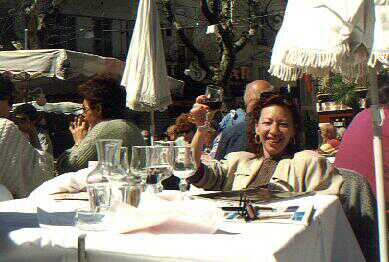 La Colombe d’Or is a miracle. Works from all the previous named painters hang
on the walls of the corridor and dining room as if there was nothing special
(the entire collection was once stolen in 1960 but found back in a rail station
luggage deposit in Marseille). When I was there I had a view on a Jacques
Villon, Miro, Picasso and Dubuffet. Next to the swimming pools an impressive”
La Colombe d’Or is a miracle. Works from all the previous named painters hang
on the walls of the corridor and dining room as if there was nothing special
(the entire collection was once stolen in 1960 but found back in a rail station
luggage deposit in Marseille). When I was there I had a view on a Jacques
Villon, Miro, Picasso and Dubuffet. Next to the swimming pools an impressive”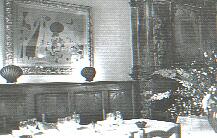 mobile
“ of Calder is philosophing, while the backside of the terrace is occupied by
ceramics of Fernand Leger. If you are like me, a simple tourist with normal
budget have a kir drink near the beautiful pool. It will not ruin you. Alas, it
must be said that the cuisine never reached the level of the ambience. But the
hotel itself is charming, cosy even, a feast of warm terracotta, bright ceramic
tiles, painted wooden ceilings and burnished wood. mobile
“ of Calder is philosophing, while the backside of the terrace is occupied by
ceramics of Fernand Leger. If you are like me, a simple tourist with normal
budget have a kir drink near the beautiful pool. It will not ruin you. Alas, it
must be said that the cuisine never reached the level of the ambience. But the
hotel itself is charming, cosy even, a feast of warm terracotta, bright ceramic
tiles, painted wooden ceilings and burnished wood.
Next article we visit the village of Saint-Paul.
Bibliography:
John
Pemble, "the Mediterranean Passion, Victorians and Edwardians in the
South", (Oxford University Press 1988), Mary Blume, "Cote d'Azur.
Inventing the French Riviera" (Thames and Hudson, London 1982) Stephen Liegeard,
"La Cote d'Azur (Ed.Serre, Nice 1988), Guide du Routard 1998-99, Patrick
Howarth, “When the Riviera was ours” (Century, London 1977, Arriere pays de
Cannes et Nice”, Henri de Langlais (ed. Duroche,
Nice 1996), « La Colombe d’or, histoire d’artistes”, by J.Greenfeld
(ed. Beaux-Sites, Cannes 1998)
|