|
It is difficult to
dissociate St.Raphael and Frejus completely imbricated one into another. You don’t
notice when you leave St.Raphael to enter Frejus. Especially during the summer
when it’s overcrowded. If this region is rather overshadowed by its world
famous neighbours such as Saint-Tropez to the east and Cannes to the west, it is
by any means worth our attention.
Saint-Raphael, built in terraces (26,000 citizens) is a modern family bath
resort with a large well-maintained sand beach (La Veillat), especially fit for
children. It’s rare that winter temperatures go below 11 Celsius.
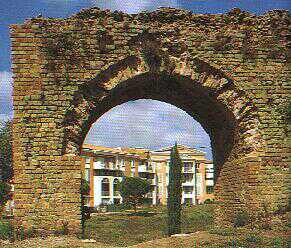 Forum Julii was founded in 43 B.C. as a market place by Julius Caesar. A halt
for the Roman troops on their way from Spain to Italy. When emperor Augustus
decided to house the 8th legion in Forum Julii, this city became on of the most
important
Forum Julii was founded in 43 B.C. as a market place by Julius Caesar. A halt
for the Roman troops on their way from Spain to Italy. When emperor Augustus
decided to house the 8th legion in Forum Julii, this city became on of the most
important
Frejus was during the Roman period one of the most marine bases of the western
Mediterranean. The biggest ships could come into centre town thanks to a 500 m
canal, which had a 2 km long stone quay. In 31 B.C. the inhabitants had the
opportunity to go and see the galleys captured during the battle of Actium from
Cleopatra by Caesar.
Years went by and the laguna started to cover with sand from the 2nd century.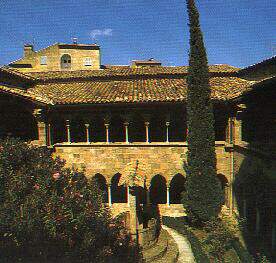 Activities declined and stopped completely. When you loiter inside Frejus today,
no hair in your head would believe that once the sea was just next to you. The
distance to Frejus Plage must be 3 km now.
Activities declined and stopped completely. When you loiter inside Frejus today,
no hair in your head would believe that once the sea was just next to you. The
distance to Frejus Plage must be 3 km now.
Thus Frejus joined Aigues-Mortes at the Pantheon of great dead harbours and
disappeared out of the news just coaxing his Roman vestiges.
Napoleon made the news two times in Frejus. The first was when he disembarked
after his campaign in Egypt in 1799 and the second time when he embarked in 1814
to join his exile to the island Elba.
In the large delta of the Massif des Maures and the Corniche de l’Esterel, the
land was fertile but the danger of floods were real since the Royan and Argentan
could become sometimes very wild in the winter. To avoid a permanent water
shortage in Frejus, a dam was in the Reyran in 1954, 10 km upstream the hamlet
of Malpasset. The dam was 60 m high and could contain 50 million cubic m, but it
exploded like a bomb after an intense rainy period on 2nd December 1959 13
minutes after nine. Twenty-one minutes later the all-destroying water reached
Frejus. Thousands of hectares of fertile were destroyed, hundreds of houses
collapsed, 450 people drowned or died.
I mixed maybe a little bit Frejus with Saint-Raphael but you cannot dissociate
them really. St.Raphael is a resort and Frejus is the place with all the roman
remains we will visit in our next essay.
Bibliography:
John
Pemble, "the Mediterranean Passion, Victorians and Edwardians in the
South", (Oxford University Press 1988), Mary Blume, "Cote d'Azur.
Inventing the French Riviera" (Thames and Hudson, London 1982), Stephen
Liégeard, “La Cote d’Azur” (Ed.Serre, Nice 1988 a reprint), “La
Provence des origines à l’an mil, by P.A. Fevrier (ed.Ouest-France 1989),
Dictionnaire de le France médiévale”, by Jean Favier (Fayard , Paris 1993)
|