|
From Nice to Menton
Nice
From Nice to
Menton-an itinerary
Villefranche-sur
mer
Saint-Jean-Cap
Ferrat
Beaulieu-Villa
Kerylos
Eze
perched village
Monaco
La
Turbie
Roquebrune-Cap Saint-Martin
Menton
From Nice to
Saint-Tropez
Cagnes-sur-Mer
Saint Paul de Vence
Vence-Matisse
chapel-City
Tourettes-Gorges
du
Loup-Gourdon
Grasse
Cabris and Valbonne
(anecdotes!)
Biot
Antibes
|
CASSIS is the preferred weekend spot for the people of Marseille. Despite it is considered as a picturesque and charming fishers village, very quite, OUT OF SEASON, please! it possesses none of the glamour or urbanity of Saint-Tropez or Cannes. But maybe that's where its charm is hidden! Yu can still have a taste of the ambience and atmosphere of the ancient South of France village, like it as taken down for eternity by many painters, and that has disappeared almost completely in other parts of the Mediterranean. It was also a main inspiration spot for the Provencal poet Mistral. Painters like Derain, Dufy, De Vlaeminck and Matisse lived here.
It is also blessed with the coolest water along the French Mediterranean, thanks to a series of underwater steams. The port is hard to beat for sheer natural beauty, especially at dusk, when iridescent shades of light dust over the harbour.
But please, come before the high season starts. Like in May, June or September, when the sun is still hot and the crowds are gone. In full season it is hopelessly overbooked and overcrowded.
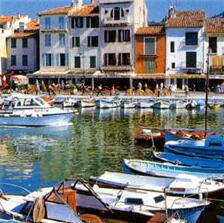 Cassis, already known in Roman antiquity, then called Carcisis Portus, is not only fit for strollers but also for windsurfers and sport fishers. Beaches are very crowded and not so practical for children because the clear water deepens abruptly. Cassis, already known in Roman antiquity, then called Carcisis Portus, is not only fit for strollers but also for windsurfers and sport fishers. Beaches are very crowded and not so practical for children because the clear water deepens abruptly.
Cassis is known for three disasters: in 1720 the plague killed15,000 out of its
26,000 inhabitants. The second disaster began after the execution of Lous XVI ,
when Toulon's royalists confided the city to the English and their Spanish
allies. And finally, in 1793 a ragamuffin Revolutionary army of volunteers and
ruffians, aftre having massacred 6,000 people in Bordeaux, arrived at the gate
of Toulon and began an ineffectual siege of the city. Aftre two months a certain
Napoleon Bonaparte received the permission to bombard and shell the city.
But the rocky coast with its numerous "calanques " is a haven for divers. If you don't dive but are interested to sea life under water, you can make a trip with the trimaran of Jacques Rougerie. This architect designed himself a unique glass bottom boat.
The small centre of Cassis, lying next to the round, natural harbour, has narrow but straight streets. Old hotels with terraces surround the harbour basin in a half circle arch form.
The lively port is still full of colourful fisher boats, which became a rarity in other ports of France. And fish is sold directly form the boat on the quay. A street market is held every Wednesday and Friday morning.
And if you are looking for fun and more, Cassis can offer you a casino, a few nightclubs and a movie theatre. But don't expect to find a wild nightlife here
Don't forget to taste the local white wine, smelling rosemary, myrtle and heather. Its one of the oldest AOC wines of France, le Vin de Cassis. You can see the vineyards all around you I the hills surrounding the village.
 |
|
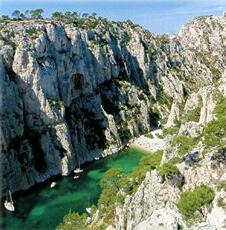
Calanque Port en Vau |
 |
|
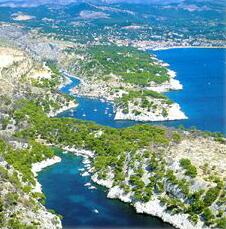
Calanque Port Pin |
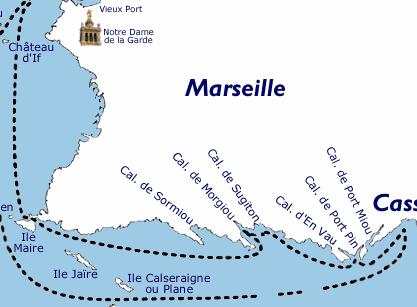
The end-all of any visit to Cassis has to be a visit to the calanques, picturesque notchescarved in the coastline of Cassis(towards Marseille). Let's pick the most important. The first inlet, reachable by car is PORT MIOU, and it is dedicated to harbouring yachts. The second is PORT PIN, named like that because of the shrubby pines that decorate its rocky walls. You can approach that one only by foot or by boat. The most incredible of all calanques is the breathtaking PORT EN VAU. Similar to a Norwegian fjord, sky-high white cliffs cut directly down into water of the deepest blue-green imaginable. If you happen to be on top, you will experience something never to be forgotten but beware-it is not easy to get up there and not easy to get down again. To do it in all security, it would be best to take a guide or a boat to Port en Vau. And I repeat, once again, none of these places are going to look like paradise during the high season, unless you like naked Scandinavians and countless families with little dogs and picnic baskets. Even the waters start to float with empty wrappers.
(Updated 12 January 2001)
Bibliography
Mary Blume, "Cote d'Azur. Inventing the French Riviera" (Thames and Hudson, London 1982), The Twenties, From Notebooks and Diaries of the Period, by Edmund Wilson (Cannes 1921), "Oostkust aan Middelandse zee", by Koos Steenhouwer (1998), "The Mediterranean passion", by John Pemble (Oxford University Press1988), Aspects of Provence, by James Pope Hennessy, "Cassis, familieoord voor de westkust", by J.Groenendijk (Elsevier 1997)
|
From Nice to Saint-Tropez (suite)
Cap
d'Antibes
Juan les
Pins-Golfe-Juan-Vallauris
Cannes
Iles
de Lerins
La
Napoule and Henry Clews
Esterel
cornice to Frejus
Frejus
Sainte Maxime to Port Grimaud
Old Grimaud and Cogolin
Saint-Tropez
From Saint Tropez to Cassis
Ramatuelle-Gassin-Croix
Valmer-Cavalaire
sur mer
Le
Lavandou-Bormes les Mimosas
Hy�res
Island of
Porquerolles
Island of Port Cros - Ile du
Levant
Toulon
From Toulon to
Sanary-sur-Mer
Bandol
and island of Bendor
La
Ciotat and route des Cretes
Cassis and the calanques
|