|
As a bonus to
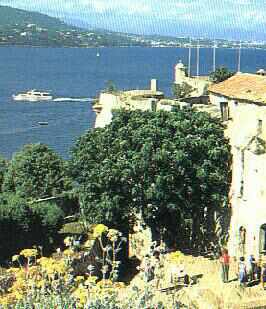
our stay in Cannes, let’s make a trip to the Iles de Lérins and get lost in
medieval ages, when monks settled down to turn against the outraging wealth in
the world. To get to these islands we have first to walk to the Gare Maritime
next to the Palais des festivals and find a boat. At least one an hour leaves to
Sainte-Marguerite or Saint-Honorat. The whole trip lasts half an hour.
About the history of these islands we must find out that here are very few
remnants to testify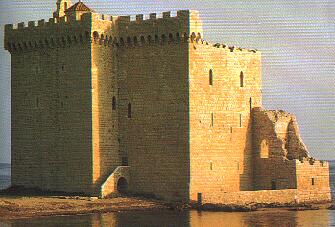 about that history. It is useless to describe in the finest details all the
murderous and inhuman facts that took place here perpetrated by the Saracens and
also the Catholic Spaniards of Charles V, operations where monks were burned at
the stake or stabbed to death. It resulted in the building of an immense tower
at the south side of the island Saint-Honorat, in fact a fortified cloister. In
the 16th century a visitor counted 90 rooms of which 36 cells for the monks and
five for the servants. Four chapels, two wells and hundred windows.
about that history. It is useless to describe in the finest details all the
murderous and inhuman facts that took place here perpetrated by the Saracens and
also the Catholic Spaniards of Charles V, operations where monks were burned at
the stake or stabbed to death. It resulted in the building of an immense tower
at the south side of the island Saint-Honorat, in fact a fortified cloister. In
the 16th century a visitor counted 90 rooms of which 36 cells for the monks and
five for the servants. Four chapels, two wells and hundred windows.
When Prosper Mérimée visits the island during his inventory travels and
arrives in St.Honorat in 1834 he is fascinated by the maze of stairs and
corridors that connected in a bizarre way. Mérimée reminds us the horror
novels of Ann Radcliffe (1764-1823) and her “dream castles” “made
especially to play at hide “. And from the terrace of the cloister tower Mérimée
discovered “one of the most beautiful panoramas in the world, meaning the
massif des Maures, the Esterel with Cannes and Grasse in the mountains.”
Take the earliest boat possible out of Cannes to have at least 2 a 3 hours to
visit and stroll in Saint-Honorat. In principle the boat will land at the north
side of the island where a restaurant surges out of the palm trees on the road
leading directly to the tower. The monks ask for “Silence and thank you” on
shabby boards all around the abbey but it is a difficult task. I remember an old
Cistercian monk on the boat, squeezed between a busload screaming Italian
teenagers, his eyes closed and praying intensively with his rosary to surround
himself with the silence the Cistercians chose to live.
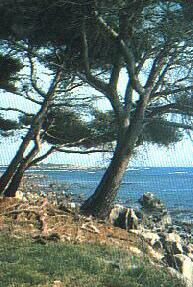 When
all our boat companions spread out under the trees after our arrival, we were
for a brief moment alone with the eternal, wonderful rushing of breakers against
the stone shores and –in the spring—the song of the nightingale or the
intoxicating odour of the white “Pittosporum tobira”, a tropical shrub all
over the place. When
all our boat companions spread out under the trees after our arrival, we were
for a brief moment alone with the eternal, wonderful rushing of breakers against
the stone shores and –in the spring—the song of the nightingale or the
intoxicating odour of the white “Pittosporum tobira”, a tropical shrub all
over the place.
I couldn’t escape the impression that the few remaining Cistercian monks who
have entrenched themselves against the invading tourists, abandoned the fight to
keep St. Honorat clean and authentic. Despite you find a garbage can every 100
meters and that shows us something about the behaviour of the visitors, I must
say that the monks themselves didn’t do such a good job in maintaining the
beauty of nature around their abbey: under the palms and other trees the shrub
is neglected and slovenly, around the cloister empty gas bottles, shredded boats
and rotten wood staples spread around like a bad farmer who mistreats his farm.
The pollen on the lavender fields is dead and the earth overgrown with grass.
Like a Dutch lady said to me, looking at all this: “The Cistercians looked
probably too deep in their own liquor glass…”
But I’m talking, talking, and we didn’t hear yet a word about how and what
to visit on this island. Let’s keep it for my next article.
Bibliography
“L’Art
Cistercien en France” by le Père Anselme Dimier (Zodiaque, Yonne, 1982),
« Notes d’un voyage dans le misi de la France », by Prosper Mérimée
(Ed.Adam Biro, Paris 1989), "Guide de la Provence mysterieuse" by
Jean-Paul Clebert (Ed.Sand, 1986), Mary Blume, "Cote d'Azur. Inventing the
French Riviera" (Thames and Hudson, London 1982)
|