|
From Valbonne to BIOT, along
the D 4 is just a formality. BIOT
is a picturesque village (pronounce " biotte"). The main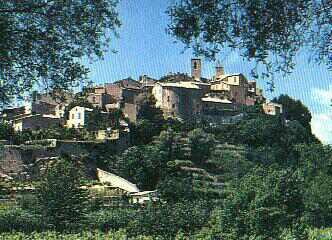 attraction
site here is of course the world known MUSEE NATIONAL FERNAND LEGER, but we will
first stay a moment in the village. attraction
site here is of course the world known MUSEE NATIONAL FERNAND LEGER, but we will
first stay a moment in the village.
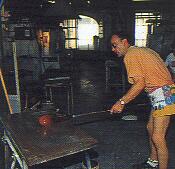 This village can be resumed in a few words: an old village on a hill with
pottery craftsmanship and glassblowers, narrow lanes and inclined "ruelles"that
house the Biot citizens in quiet retreat from the tourist oriented main streets
and shops. It’s not without charm. Everywhere you see large
decorative pots filled with flowers, standing on balconies, walls and gardens.
The large stone urns you see sometimes in the gardens of all villages along the
coast. Steep ahead you can climb to
the quite special Place des Arcades where you can have a lunch at the Gallerie
des Arcades. Menu prix fixe at lunch: 170 FF. Taste their specialty, the
"aioli". This village can be resumed in a few words: an old village on a hill with
pottery craftsmanship and glassblowers, narrow lanes and inclined "ruelles"that
house the Biot citizens in quiet retreat from the tourist oriented main streets
and shops. It’s not without charm. Everywhere you see large
decorative pots filled with flowers, standing on balconies, walls and gardens.
The large stone urns you see sometimes in the gardens of all villages along the
coast. Steep ahead you can climb to
the quite special Place des Arcades where you can have a lunch at the Gallerie
des Arcades. Menu prix fixe at lunch: 170 FF. Taste their specialty, the
"aioli".
I know you like a bit of history ;-);-) so here is some. Biot is one of these
Roman oppida built more than 100 B.C. and “cleaned “from Celts and
Ligurians. The charming place des Arcades is built on roman ruins. The Romans
already exploited the fine clay to manufacture jars for the wine and oil
transport.
Biot also shivered under the plague epidemics and became a sea pirates nest
until the “Bon Roi René” rebuilt the city from scratch and populated it
with pottery bakers from Italy. The actual street outlining dates from the 15th
century. In 1700 the bishop of Grasse ordered to erase the frescoes of the
church for indecency...Quite surprising, as you have to go downstairs to have a
chance to see them.
An interesting museum for those who like ceramics is the museum of the HISTORY AND CERAMICS OF BIOT, nice collection and guided visits.
On the chemin du Val-de -Pome, for those who appreciate bonsais, you can
visit the Bonsai Arboretum. More than 50000 bonsais on 4000 square meters.
And finally, like usual, to have the full profit of the charm of the village,
try to go early in the morning or in the evening, when the tourists have left.
The MUSEE NATIONAL FERNAND LEGER is at 3 km from the seaside, at the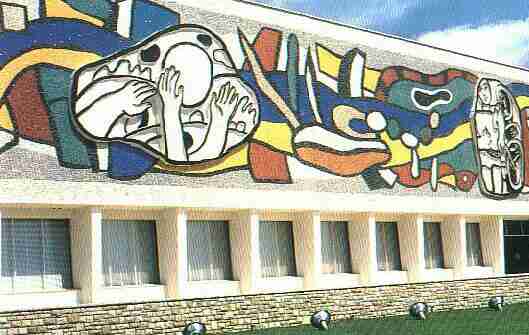 right hand side before entering the village. It stands on the spot where the
painter bought, two weeks before he died in 1955 a large “mas” with the
intention to make very large ceramics on the grounds around the mas. Thanks
to the stubborn and insisting efforts of Leger’s widow Nadia, the museum was
finally accepted. Designed and opened in 1960 by architect André Svetchine, a
contemporary artist of Leger, Braque, Picasso and Chagall. The first
right hand side before entering the village. It stands on the spot where the
painter bought, two weeks before he died in 1955 a large “mas” with the
intention to make very large ceramics on the grounds around the mas. Thanks
to the stubborn and insisting efforts of Leger’s widow Nadia, the museum was
finally accepted. Designed and opened in 1960 by architect André Svetchine, a
contemporary artist of Leger, Braque, Picasso and Chagall. The first
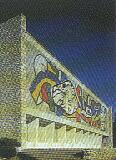 museum in
France dedicated to a single artist. During the stirring climb from the parking
spot to the main entrance we have plenty of time to study the gigantic ceramic
on the façade and that was originally destined to a sports stadium in Hannover.
In my opinion this is the weakest side of this splendid museum: the ceramic
leans to heavily on the substructure of short stilts and makes me think of an
enormous advertising board along the road. museum in
France dedicated to a single artist. During the stirring climb from the parking
spot to the main entrance we have plenty of time to study the gigantic ceramic
on the façade and that was originally destined to a sports stadium in Hannover.
In my opinion this is the weakest side of this splendid museum: the ceramic
leans to heavily on the substructure of short stilts and makes me think of an
enormous advertising board along the road.
In 1967 the building and its collection was bequeathed from Nadia Leger to the
French State and since 1991 everybody can visit the 347 works that Leger left to
his wife. It must be said that the inside architecture of Svetchine is
impressive. It is very seldom that a painter receives so much honour, where the
question rises of course: is this work worth all the fuss around?
Next article a few anecdotes about Leger’s life, Picasso and Rostropovitch.
Bibliography:
John
Pemble, "the Mediterranean Passion, Victorians and Edwardians in the
South", (Oxford University Press 1988), Mary Blume, "Cote d'Azur.
Inventing the French Riviera" (Thames and Hudson, London 1982) Stephen Liegeard,
"La Cote d'Azur (Ed.Serre, Nice 1988), Patrick
Howarth, “When the Riviera was ours” (Century, London 1977, Peter Graham,
“La France par les petites routes” (Ed.Arthaud 1988), “Fernand Leger, vie
et oeuvres”, by Fr.Berliner (ed.Presses Univ. 1996)
|