|
From Nice to Menton
Nice
From Nice to
Menton-an itinerary
Villefranche-sur
mer
Saint-Jean-Cap
Ferrat
Beaulieu-Villa
Kerylos
Eze
perched village
Monaco
La
Turbie
Roquebrune-Cap Saint-Martin
Menton
From Nice to
Saint-Tropez
Cagnes-sur-Mer
Saint Paul de Vence
Vence-Matisse
chapel-City
Tourettes-Gorges
du
Loup-Gourdon
Grasse
Cabris and Valbonne
(anecdotes!)
Biot
Antibes
|
Coming down from La Turbie,
we follow the nationale 7 direction Roquebrune and descend to CAP MARTIN. Be
careful, it’s a narrow and dangerous road and the driver gets very few
opportunities to enjoy the view. It's a short drive but an arduous climbing to
the medieval village of Roquebrune. But yet being overpriced, overcrowded
and over restored, , Roquebrune remains a magical village. Perched village above the
Grande Corniche and dominated by a stunning Carolingian fortress, the only still
intact in France according to the villagers. It should date from the 10th
century! It is nowadays a museum for old weapons and furniture.
Apricot houses , chiselled out of the rock, overhang tiny squares and blind
alleys through a labyrinth of vaulted archways.
 |
|
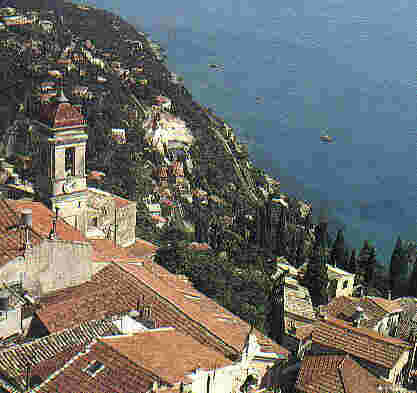
Roquebrune perched over the Corniche |
The village itself is
typical for a touristy perched village with its old streets, keeping ancient
times in memory: they form a
well-restored ensemble. Alas, the
inevitable toy and cheap articles boutiques invaded every square inch! Bit you
are not compelled to buy, you can just walk around! Particularly astonishing is
rue Moncollet, carved in the rocks. Some medieval houses have barred windows and
at the end of the impasse du Four, you can see an oven where the citizens of
Roquebrune came to bake their bread. But to have a quiet view of all this, get
there early in the morning, before the coaches start to unload their loads of
tourists.
Rue Grimaldi, the main street, is marred by cute gentrification and craft
shops. But even here the traders and craftsmen say polite and friendly, which is
not always the case in other parts of the cote. Before leaving stroll own the
rue Grimaldi up to the place des Deux Freres, a release of the slightly claustrophobic
feeling of Roquebrune.
Let's descend now To Cap Saint-Martin. The prettiest road leads along rue Souta
Riba, a narrow vaulted path edging around the outside of the village.
At first sight we see only just see an
average French village with “Bar-Tabacs” and super markets. Only at the end
of the peninsula we find something that reminds us the atmosphere from the other
caps. There the site is miraculously preserved and we can say that Cap
Saint-Martin is better preserved as Jean Cap Ferrat. However, here, no villas
are open for the public and it is unwise to label all its grand residents as
slavish followers of fashion. Here, empress Elisabeth of Austria, better known under the name of
Sissy, had her estate.. She took her
quarters at the Grand Hotel de Roquebrune-Cap-Martin. Designer Karl Lagerfeld
lives on the Cap as fragrant Coco Chanel wafted into entertain German officers
during the war. The
empress Eugenie liked to play the "grande dame" here but
presumably, the air must have done her good,
she lived 94 years !! Greta Garbo didn't come for the company. And if you’re an amateur of Mediterranean vegetation,
take the ancient customs officers path, stretching along the seaside to have the
opportunity to discover a beautiful panel of really typical Mediterranean
vegetation.
But I never got the feeling
of “living in another world” in Cap Martin. Cap Martin is not at all rich and wealthy as
Cap d’Antibes or Cap Ferrat.
The French architect Le
Corbusier moved away from his earthy existence on August 12 in 1965 when he
drowned at large of Roquebrune-Cap-Martin. Essays about recent French
architecture consider this date as a historical moment. Young architects whose
creativity was crushed since years under the dictatorship of the
“living-machine”, as Le Corbusier called the condominium-blocks-on-stilts he
built wherever he had the opportunity, like in Marseille, could breath again. In
a study about contemporary French architecture it is even mentioned that Le
Corbusier succeeded to “impose his will” to all his contemporaries” and
that after his death a new and self-thinking, deciding young generation of
architects could not develop. We have seen the dramatic- and very visible-
results. Anyway, his tomb in the cemetery uphill, you access by stairs.
Beautiful view on Cap St.Martin. In the H alley on the right is the tomb the
architect designed himself and where he rests together with his wife.
Bibliography:
Mary Blume, "Cote d'Azur. Inventing the French Riviera" (Thames and
Hudson, London 1982) Stephen Liegeard, "La Cote d'Azur (Ed.Serre, Nice
1988), Patrick Howarth, “When the Riviera was ours” (Century, London 1977),
Michel de la Torre, Alpes-Maritimes 06 (ed.Nathan, later
Deslogis-Lacoste),-Guides du Routard 1998, ed. Hchette,
Architecture et dictature by J.Michaux and A. André, ed. presses
universitaires.
|
From Nice to Saint-Tropez (suite)
Cap
d'Antibes
Juan les
Pins-Golfe-Juan-Vallauris
Cannes
Iles
de Lerins
La
Napoule and Henry Clews
Esterel
cornice to Frejus
Frejus
Sainte Maxime to Port Grimaud
Old Grimaud and Cogolin
Saint-Tropez
From Saint Tropez to Cassis
Ramatuelle-Gassin-Croix
Valmer-Cavalaire
sur mer
Le
Lavandou-Bormes les Mimosas
Hyères
Island of
Porquerolles
Island of Port Cros - Ile du
Levant
Toulon
From Toulon to
Sanary-sur-Mer
Bandol
and island of Bendor
La
Ciotat and route des Cretes
Cassis and the calanques
|