|
From Nice to Menton
Nice
From Nice to
Menton-an itinerary
Villefranche-sur
mer
Saint-Jean-Cap
Ferrat
Beaulieu-Villa
Kerylos
Eze
perched village
Monaco
La
Turbie
Roquebrune-Cap Saint-Martin
Menton
From Nice to
Saint-Tropez
Cagnes-sur-Mer
Saint Paul de Vence
Vence-Matisse
chapel-City
Tourettes-Gorges
du
Loup-Gourdon
Grasse
Cabris and Valbonne
(anecdotes!)
Biot
Antibes
|
From St.Paul de Vence to
VENCE is a 5 min climb with he car.
If I want to be honest and without any complacency I should say that Vence is an
untidy provincial town having nothing more to offer the tourist as the memories
to D.H.Lawrence, the British tuberculosis suffering author of “Lady
Chatterley’s Lover”, who died here in 1930 in a sanatorium and Matisse, who
looked for a refuge at the end of WWII. He met a nurse in Vence who had taken
care of him in Nice ion 1941. The nurse had become a catholic nun and she 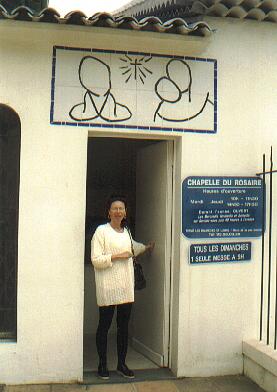 succeeded
to persuade Matisse (who felt he was in debt to the sisters) to participate at
the renovation of the local Dominican chapel of the cloister. The complete
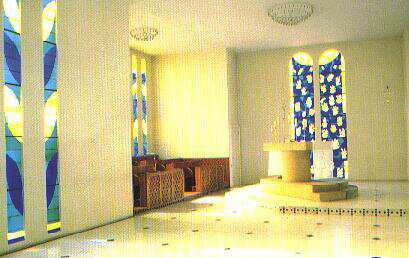
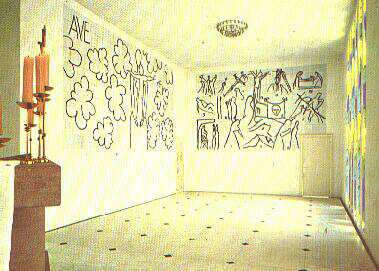
atheist Matisse designed the outside of the non inspiring CHAPELLE DU ROSAIRE,
built by architect Auguste Piret, and painted the inside in such a way that the
poet Aragon made an ironical remark:” It’s so joyful that you could turn it
into a ballroom". Matisse worked at the paintings in his apartment in Nice
where he returned in 1949. He was eighty years old at that time and painted
lying in his bed with the brush tied on a long bamboo stick. About the result we
can discuss for ages ;-). As for Matisse himself, he considered the chapel as
the achieved masterwork of his life. succeeded
to persuade Matisse (who felt he was in debt to the sisters) to participate at
the renovation of the local Dominican chapel of the cloister. The complete
atheist Matisse designed the outside of the non inspiring CHAPELLE DU ROSAIRE,
built by architect Auguste Piret, and painted the inside in such a way that the
poet Aragon made an ironical remark:” It’s so joyful that you could turn it
into a ballroom". Matisse worked at the paintings in his apartment in Nice
where he returned in 1949. He was eighty years old at that time and painted
lying in his bed with the brush tied on a long bamboo stick. About the result we
can discuss for ages ;-). As for Matisse himself, he considered the chapel as
the achieved masterwork of his life.
THE MATISSE CHAPEL is located on the road to Saint-Jeannet. Tours every Tuesday and Thursday 10.00-11.30 and 14.30-17.30.
Matisse realized the yellow and blue stained glass, based on leaf motif,
and instead of frescoes he painted his designs for the wall. Unfortunately a few
of his Stations of the Cross wall cracked when the building was set. Many of the
original drawings are on display but the details are of the greatest interest:
the candlesticks on the altar and the confessional door.
But let’s, despite the commercialism of the city, pay a visit to Vence.
 The
old ellipse shaped part of the city is only visible on foot. So leave you car at
the entrance of the city on the place du grand Jardin. It’s the centre
of modern Vence. Proceed from there to the place du Frene (ash-tree). This tree
remembers a visit of king François 1er and pope Paulus to the city and was
planted in 1538. It seems to be a botanical curiosity: such trees rarely grow in
altitude, even if it's only 325 meters high. The
old ellipse shaped part of the city is only visible on foot. So leave you car at
the entrance of the city on the place du grand Jardin. It’s the centre
of modern Vence. Proceed from there to the place du Frene (ash-tree). This tree
remembers a visit of king François 1er and pope Paulus to the city and was
planted in 1538. It seems to be a botanical curiosity: such trees rarely grow in
altitude, even if it's only 325 meters high.
 |
|
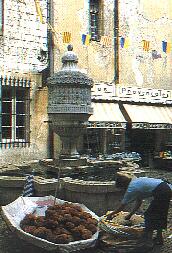
Place du Peyra |
The entrance of the Portail
du Peyra leads to the place du Peyra which has a large chestnut tree
shading the cafes. It is the location
of the old Roman forum and an adorable little place, enhanced by 3 fountains,
dating 1822. Via the
rue du Marché (right) and the ruelle du Marché (an alleyway left) you
arrive at the former cathedral at the place Clemenceau, where a flea
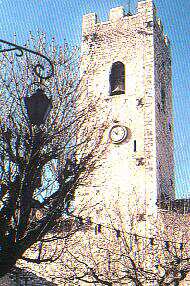
market is held every Wednesday. The cathedral, with its 15th century watchtower
is mainly from the 11th century and was the site of the temple of Mars in Roman
times. The nave has four aisles. On the side aisles , which contain the chapels,
one is said to contain the body of St. Veran (died 492). But the most stunning
and beautiful is the rostrum, a tribune added in 1499, housing the choir stalls
. Carved animals and plants recorded the daily life of people and clergy ,
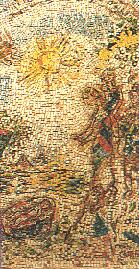
sometimes not at all reverently! Finally, in the baptistery there is a mosaic
design by Marc Chagall of Moses in the bulrushes.
 |
|
Chagal mosaic in cathedral |
Back outside, the recently
refurbished town hall looks good. Loitering through the streets of the inner
city you will be confronted all the time by the so-called “craftsmen” and
“artists”, that name indignant.
To be complete let’s name the picturesque little place Surian with his mini morning market with the good smells of the Provence
products.
I'll give you exceptionally an address for lunch or dinner: " Le Pigeonnier",
3-7 Place du Peyra on three levels with a terrace. Menus 105 FF and 155 FF.
Reservation in the summertime is absolutely imperative.
Next article will take us to Tourrettes sur Loup via the THE
GALERIE BEAUBOURG
Bibliography:
John
Pemble, "the Mediterranean Passion, Victorians and Edwardians in the
South", (Oxford University Press 1988), Mary Blume, "Cote d'Azur.
Inventing the French Riviera" (Thames and Hudson, London 1982) Stephen Liegeard,
"La Cote d'Azur (Ed.Serre, Nice 1988), Guide du Routard 1998-99, Patrick
Howarth, “When the Riviera was ours” (Century, London 1977, Arriere pays de
Cannes et Nice”, Henri de Langlais (ed. Duroche,
Nice 1996).
|
From Nice to Saint-Tropez (suite)
Cap
d'Antibes
Juan les
Pins-Golfe-Juan-Vallauris
Cannes
Iles
de Lerins
La
Napoule and Henry Clews
Esterel
cornice to Frejus
Frejus
Sainte Maxime to Port Grimaud
Old Grimaud and Cogolin
Saint-Tropez
From Saint Tropez to Cassis
Ramatuelle-Gassin-Croix
Valmer-Cavalaire
sur mer
Le
Lavandou-Bormes les Mimosas
Hyères
Island of
Porquerolles
Island of Port Cros - Ile du
Levant
Toulon
From Toulon to
Sanary-sur-Mer
Bandol
and island of Bendor
La
Ciotat and route des Cretes
Cassis and the calanques
|