 |
|
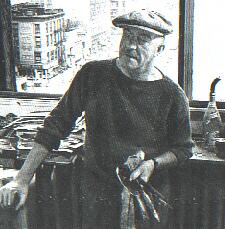
Leger in New York |
Fernand Léger was born in
Argentan in Normandy. He started to work in an architect office but soon became
a painter. His first work shows clearly the impressionist influence, after that
it was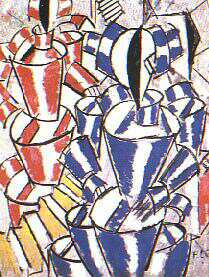 Matisse and the Fauves influence. Then Cezanne became his favourite and he
participates in the cubist adventure. In 1911 Kahnweiler, the genius art
merchant who also discovered Picasso and Braque, noticed him. But the big revelation comes when he goes as a soldier to the front in
WWI. “Not alone” was he there” like he said, “shoulder to shoulder with
the whole French nation” but “was also blinded in full sun by the magic of
the light on white metal and canon”. Leger always said later:” After the war
I used everything I learned at the frontline”.
Matisse and the Fauves influence. Then Cezanne became his favourite and he
participates in the cubist adventure. In 1911 Kahnweiler, the genius art
merchant who also discovered Picasso and Braque, noticed him. But the big revelation comes when he goes as a soldier to the front in
WWI. “Not alone” was he there” like he said, “shoulder to shoulder with
the whole French nation” but “was also blinded in full sun by the magic of
the light on white metal and canon”. Leger always said later:” After the war
I used everything I learned at the frontline”.
|
|
|
Farewell to New York |
Leger was not an
intellectual, but a simple, uncomplicated and friendly man, adored by his pupils
and working hard day and night like a simple worker. His biggest goal was to
make “the cleaning lady and the workers at Renault” make understand what he
did. He was also a ceramist, a sculptor, glassmaker and a passionate drawer.
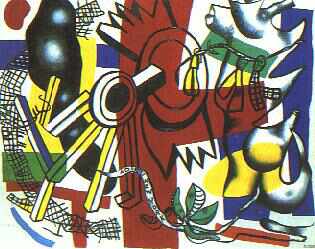
During WWII he immigrated to New York, where the massive and impressive
architecture inspired him. Legers passion for mechanics shows in its enormous
constructions with small, brave men forming an inextricable unity with pipes,
beams and metallic objects, not to forget the bicycles!
Léger and Picasso had the same age. They knew each other from the wild days of
cubism and when Leger came in 1951 to Biot, Picasso was not far, in Antibes.
About this period, Picasso’s companion, Françoise Gilot reports in her book:
”Life with Picasso”’. She tell that Picasso never had any interest in Léger’s
work and Pablo explained to Françoise:” his work is always a little bit
outside great painting, there is not enough in his art for me, it is open and
honest but doesn’t mean anything more than what you see”. I think that is
the right opinion we must have about 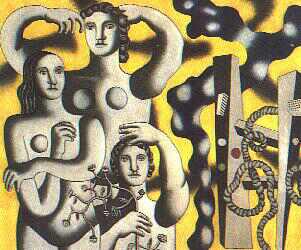 Léger’s
work. It is also amusing to read in Gilot’s memoires how she felt about Nadia
Léger. A goodish, but stupid and stubborn Russian moujik woman. But she was not
so “goodish”, our Nadia Petrovna Léger: the Russian world famous cellist
Mstislav Rostropovitch unveiled in summer 1994 that Nadia Petrovna Léger sent a
letter in 1974 to the KGB saying that Nadia called Rostropovitch and his wife
(singer Galia Visjnevskaya) “ filthy pigs” and even added:” that
Rostropovitch and his wife should stay in the West because they were unable to
show their gratitude to the Soviet-Union, who teached them and promoted them
(?)”. Rostropovitch told in an interview to Léger’s
work. It is also amusing to read in Gilot’s memoires how she felt about Nadia
Léger. A goodish, but stupid and stubborn Russian moujik woman. But she was not
so “goodish”, our Nadia Petrovna Léger: the Russian world famous cellist
Mstislav Rostropovitch unveiled in summer 1994 that Nadia Petrovna Léger sent a
letter in 1974 to the KGB saying that Nadia called Rostropovitch and his wife
(singer Galia Visjnevskaya) “ filthy pigs” and even added:” that
Rostropovitch and his wife should stay in the West because they were unable to
show their gratitude to the Soviet-Union, who teached them and promoted them
(?)”. Rostropovitch told in an interview to 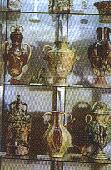 the “Figaro” paper that he
received the letters from the KGB after the collapse of the soviet regime. the “Figaro” paper that he
received the letters from the KGB after the collapse of the soviet regime.
What excited me most inside the museum Léger was the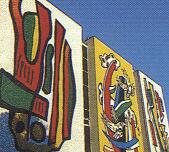 extensive photo gallery of
Leger’s life.
extensive photo gallery of
Leger’s life.
The 1st floor shows clearly how his art evoluated through its periods, from the
etude for "La Femme en Bleu" where he
breaks off with impressionism by introducing pure colours
until his master work: "Les Constructeurs" (1950). Second floor is
dedicated to ceramics, window of glass
tiles, wall covers, mosaics, tapestries, glass works and ceramics
Bibliography:
"La
Cote d'Azur (Ed.Serre, Nice 1988), Guide du Routard 1998-99, “Fernand Leger, vie et oeuvres”, by Fr.Berliner (ed.Presses Univ.
1996)-« Life with Picasso » by Fr.Gilot (ed. Grasset
1968)-“l’Aventure de l’Art au XXème Siècle”, by Jean-Louis Ferrier
(ed. Chene-Hachette 1993)
|