Louvre French painting Paris Site Home - What's New?-Feedback - About Jack-Travel/Art Links


Paris Shopping Paradise!!

Paris sketches (daily life)

Hidden, unknown Paris 

Secrets Notre Dame 
Paris

Paris impressionist walk

Paris literature walk

Paris flea and other markets

10 very special shops

Parisians in Paris

Paris bridges

Special shops in Passy

Unknown parks and gardens

Louvre

Introduction

A little bit of history

Louvre figures and vandals

Schedules, prices, passes

Fast Louvre

Oriental antiquities

Greek, Etruscan, Roman antiques

French painting section

Flemish painting section

More foreign paint section

Italian painting section

Sculpture section

Paris-Louvre-French Medieval painting until Poussin

Paris main page

...discover  PARIS THROUGH THE AGES in the very best way possible :on foot with your own personal guide !!!!! Les Hoteliers de Paris. 
A useful tool. Book now!

Paris dining world!!!!

Book a Paris hotel on line


Medieval until Poussin

Poussin to Vigee Lebrun

Greuze to Corot

Big format paintings

Of all the museums in the world, the Louvre may not have the largest number of paintings but has certainly the most complete. It’s origin being the “cabinet des tableaux” assembled in Fontainebleau by François 1er, this collection, largely enriched by Louis XIV, increased after the fall of Royalty by confiscations on church belongings and emigrates (nobility). Follow the victories of the revolutionaries and the seizures operated in different European countries.
Its presentation occupies almost the entire second floor of the Richelieu wing, the Cour carrée and the part located at the first floor of the Denon wing, east of the gallery Apollon.
Let’ start in the Richelieu wing on the second floor and continue (always on the 2nd floor) all along. Site Home

200 works, from the primitives to Poussin, are visible in the 18 new galleries designed by I.M.Pei.
Key masterpieces of medieval painting are on display in the different rooms: the anonymous “Portrait de Jean le Bon in room 1 painted about 1350. The oldest known French easel painting and well kept portrait of the 14th.

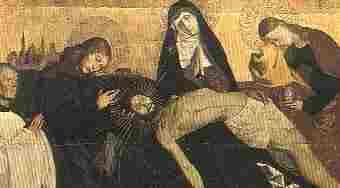
Pieta Villeneuve

Room 6 has the famous " Pieta of Villeneuve-les-Avignon ", austere and grandiose chefd’oeuvre of the end of the medieval era, attributed today to Enguerrand Carton. First influences of the Renaissance can be seen here.
Rooms 7 and 8: the 16th century portrait painters represented by Clouet, portrait of Francois 1er, draught by pencil, seen full face and small format.
Rooms 9 and 10: Italian decorators arrive in Fontainebleau (Leonardo da Vinci, Rosso, il Primatice), invited by Francois 1er and introduce a sort of  " mannerism" that shakes up the French genre. It is full of elegance and refinement like the “Diane chasseresse”, by an unknown master and where experts think they recognize the idealised portrait of Henri II’s favourite, Diane de Poitiers.
Room 11: it’s in Italy, especially in Rome that the French painters look for inspiration to react against the excesses of mannerism. Most of them like Valentin, Vouet, will turn to the naturalist movement issued out of the art of Caravaggio. His popular or religious themes, his contrasted and dramatic lighting will influence them immensely.

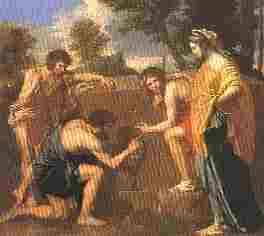
Nicolas Poussin


Master by excellence of French classicism, theorican, philosopher, poet, Nicolas Poussin, who spent almost his entire life in Rome, was, more than anybody else, haunted by the worry of perfection and where the landscape, behind the religious theme, will takemore and more importance.

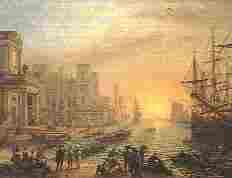
Claude Gellee

You can see a quarter of his works, present at the Louvre, I, rooms 13, 14, 16, 18. “Les Bacchanales),  “Autoportrait” and a splendid octagonal gallery (16) was specially imagined for Poussin's "Les Quatre Saisons".
In room 15, Claude Gellee, said “le Lorrain”, is more concerned with the study of light effects, the variations happening during different moments in the day and the reflections on water. That is enough to make him a precursor of Impressionism: "Port de mer au soleil couchant".  

Bibliography:

The Louvre, Seven Faces of a Museum; The Louvre (Collection Guides Gallimard); The Louvre-the Museum-the Collections-the New Spaces (Connaissances des Arts); Louvre, la visite, Pierre Qouniam (Reunion des Musees nationaux).