|
Gallery 28 (Sully wing):
Georges de La Tour is at his best. Gallery 28 (Sully wing):
Georges de La Tour is at his best. He loves intimate and night scenes where he can give a mystery ambience at candlelight, with a very personal
simplification of forms and sober harmony of colours, mostly religious themes,
his mysticism expressing itself in a simplified use of strongly directed light.
In “Saint Joseph charpentier” the candle flame lights a dramatic and humble
setting in which St. Joseph passes on his worldly knowledge to the young Jesus,
with a painful premonition in his eyes of the tortures of the Cross. We can
classify him to the provincial painters in France working in a Caravaggiesque
style up until the middle of the 17th century.
where he can give a mystery ambience at candlelight, with a very personal
simplification of forms and sober harmony of colours, mostly religious themes,
his mysticism expressing itself in a simplified use of strongly directed light.
In “Saint Joseph charpentier” the candle flame lights a dramatic and humble
setting in which St. Joseph passes on his worldly knowledge to the young Jesus,
with a painful premonition in his eyes of the tortures of the Cross. We can
classify him to the provincial painters in France working in a Caravaggiesque
style up until the middle of the 17th century.
Gallery 29: Of the brothers Le Nain, even more attracted to the expression of familiar reality, Louis is
certainly the one who shows us the most humble lives, together with their
rusticity, in a sensibility without any exaggeration: " Famille de paysans
dans un interieur”. Born in Bourgogne in Montbavin, near Laon, the brothers
painted about 60 paintings but the
historians aren’t sure who painted what.
Galleries 31,32: if you like religious paintings of the 17th have a
ball.
Gallery 36: here comes Watteau, opening new roads, renewing subjects and
techniques.
 |
|
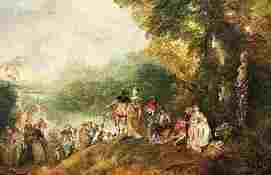
Pelerinage a l'ile de Cythere |
Born in Valenciennes in
1684, not much is known about Watteau's family except that his father was a tile
maker who was prone to drinking and brawling. It was perhaps also his Flemish
background that gave to Watteau his admiration of Peter Paul Rubens, who was the
main influence on Watteau's formative years. Watteau also studied the great
Venetians and in particular appreciated Veronese and Titian.
In addition to being a vibrant
colorist, Watteau was a superb draftsman. Hundreds of his drawings survive which
show his concentration on the human form. He drew from life and his drawings are
studies of hands, fingers, and limbs executed in his favourite media, trois
crayons. A master of nuance, Watteau's ability to express specific gestures,
attitudes and poses is virtuoso and these drawing are much sought after today. I
this gallery you will be able to see the famous Pierrot portrait called "
Gilles", " Nymphe et Satyre, " Pelerinage a l'ile de Cythere".
 |
|
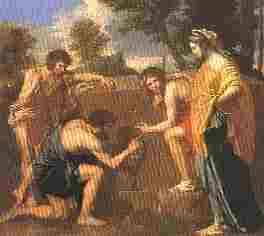
Nicolas Poussin |
Master by excellence of French classicism, theorican, philosopher, poet,
Nicolas Poussin, who spent almost his entire life in Rome, was, more than
anybody else, haunted by the worry of perfection and where the landscape, behind
the religious theme, will takemore and more importance.
 |
|
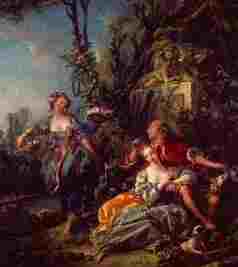
Francois Boucher |
The next galleries are all
about French painting in the 18th century. (36 to 49) like the
“salle Boucher” in 46. Francois Boucher was unmatched by his contemporaries
in versatility, consistency and output. For many, his sensuous beauties,
coquettish milkmaids and plump cupids represent the French eighteenth century at
its most typical. Here we can see"l'Enlevement d'Europe", and "
Les Forges de Vulcain"
Gallery 48 (Salle Fragonard): French painter of the rococo style, who became a
favourite in the courts of Kings Louis XV and Louis XVI for his delicately
colored scenes of romance. He was influenced by the paintings of Venetian master
Giovanni Battista Tiepolo. His works are characterized by fluid lines, frothy
flowers amid loose foliage, and gracefully posed figures. His chief work was a
series of decorative panels commissioned by Madame du Barry, mistress of Louis
XV, including the paintings The Pursuit and The Lover Crowned (both 1771-1773,
Frick Collection, New York City). Here we can admire “Les Baigneuses”
(1770). In the same gallery, homage to Vigee-Lebrun, who realized a superb
portrait of Hubert Robert. She was the portraitist of Marie-Antoinette and the
female court like the princess of Polignac. Received at the Academy in 1785, she
lived a brilliant life. Her style, first influenced by Rubens influenced par
Rubens, turned to neoclassicism like David. Back from exile in 1802 she painted
landscapes from 1810 on.
Bibliography:
The Louvre, Seven Faces of a Museum; The Louvre (Collection Guides Gallimard); The Louvre-the Museum-the Collections-the New Spaces (Connaissances des Arts); Louvre, la visite, Pierre Qouniam (Reunion des Musees nationaux);
Painting and Sculpture in France 1700-1789, by Michael Levy (Yale
University Press., New Haven and London, 1993.); Watteau's Painted Conversations
by M. Vidal (New Haven and London. 1992)
|
