|
Louvre French painting Paris Site Home - What's New?-Feedback - About Jack-Travel/Art Links |
|
Louvre Introduction Greek, Etruscan, Roman antiques French painting section
More foreign paint section |
Paris-Louvre-French painting section-Big format paintings |
||||||||||||||||
| ...discover PARIS THROUGH THE AGES in the very best way possible :on foot with your own personal guide !!!!! |
Les
Hoteliers de Paris. A useful tool. Book now! |
||||||||||||||||
To
finish about French painting let’s now take a look in the three rooms, first
floor, Denon wing, in halls 75, 76, 77 “large format French paintings”.
Immense format paintings from
end 18th and beginning 19th
are proposed. Try to move back the farthest possible to be impressed by their
size.
Presented at the salon of
1819 it is often considered as the first expression ofFrench pictorial romantism.
The impetuosity and dramatic intensity shown in the description of this
“faits-divers”(the survival of 15 shipwrecked of a fregate that left for
Senegal on July 1816, make it one of the key master pieces of the Louvre
collection. Extraordinary moments,
rendered by the exhausted bodies rising progressively from the left to the right,
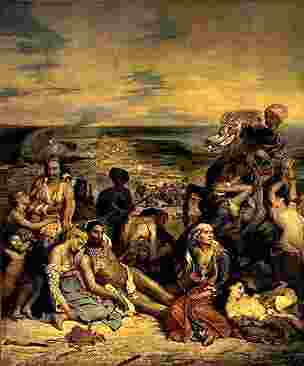
when sighting the saviours ship. The public was deeply But it would be almost criminal to neglect a capital aspect of the art of this sumptuous colourist if I wouldn’t mention “Femmes d’Alger”, "Dante et Virgile”, "Le Massacre de Scio ", where light
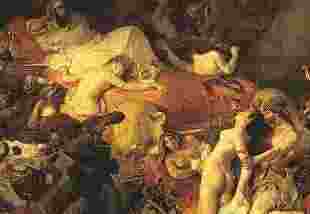
plays such an important part. My favourite is " La Mort de Sardanapale” presented at the Salon in 1827, a barbaric feast, inspired by a poem of Lord Byron where the poet saw on the canvas his own romantism. It’s an exotic and erotic challenge to classic painting. Tumultuous work, quintessence of romantics, it creates a scandal. Prominent writers defend the work: Theophile Gautier writes: “We cannot not follow indefinitely the David school. Others describe it as a convulsive work, a sadistic fantasy, “ a reformed way of painting”, anarchy, throwing the spectator into confusion since the “artistic rules” are not respected anymore. A certain Ludovic Vitet (liberal press) worries that this kind of painting could triumph on the “faithful of the church”’.
Delacroix is art for art. He
wished being a poet, but painting replaced the pencil. I advise you a very good
book, I don’t know if there is an English translation of it: “Delacroix” by Stéphane Guegan (Flammarion). Il He takes us with him
to the core of the painter’s atelier. You will find there painting, of course,
but also rough material, sentiments , anguishes and passions.
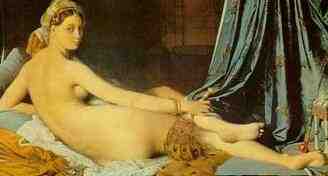
In the same halls,” La Grande Odalisque” by INGRES. Ockman C., in “Ingres's Eroticised Body,states that (begin of quote): Ingres's painting reduces the female to a passive object and she is disturbed that, at best, it places the female body in the same sphere as deformity. She continues on to suggest that even though the painting smacks of masculinity, the sensual aspects of it can be reclaimed and reconstituted by using the "fluidity of form to defy boundaries instead of the formlessness that has always been associated witht he work." “ (end of quote).
Ingres looks here for
perfection ( he was obsessed by Raphael). An expert, looking very closely,
noticed the presence of three supplementary vertebras, which adds more
lasciviousness to the pose. It's
not a back, it's a grand piano! We are beyond the real! Bibliography The Louvre, Seven Faces of a Museum; The Louvre (Collection Guides Gallimard), Jean Francois Millet: His Life and Letters by Julia Mary Cartwright Ady (Published 1971), Drawn into the Light: Jean Francois Millet, by Alexandra R. Murphy (Published 1999), Ingres then and now (Visions: Critical Studies in the History and Theory of Art), by Adrian Rifkin, " Jean-Auguste-Dominique Ingres, by Robert Rosenblum (From Abrams' Masters of Art series), Eugene Delacroix 1798-1863, The Prince of Romanticism, by Gilles Neret, Delacroix, by Barthelmy Jobert.: the definitive Delacroix monograph, from the world's foremost expert on his art, “Ingres's Eroticised”, by Body Ockman C., “Delacroix” by Stéphane Guegan (Flammarion) |
|||||||||||||||||
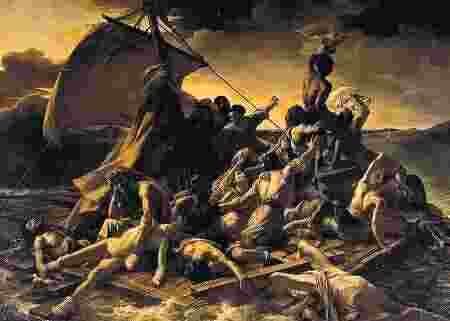
 shocked
by the realism of the bodies and the greenish colours, but Gericault couldn’t
care less. Triumph of colour, movement and passion: a revolution. Which oil
canvas of the 60 exhibited in the Louvre of this genial artist will be the best
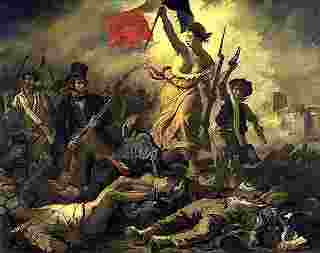
illustration? Who am I talking of? Eugene DELACROIX, of course. Maybe you will
prefer the “Taking of Constantinople by the Crusaders” to the famous
“Liberté Guidant le peuple”?
shocked
by the realism of the bodies and the greenish colours, but Gericault couldn’t
care less. Triumph of colour, movement and passion: a revolution. Which oil
canvas of the 60 exhibited in the Louvre of this genial artist will be the best
illustration? Who am I talking of? Eugene DELACROIX, of course. Maybe you will
prefer the “Taking of Constantinople by the Crusaders” to the famous
“Liberté Guidant le peuple”?