|
Hector Guimard, life and work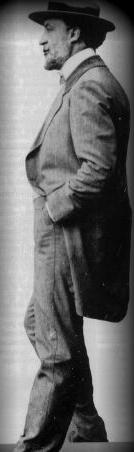
return
to Paris main page
Hector Guimard, surnamed Mr.Noodle". You heard already about him. Whenever I had the opportunity I mentioned him and his crazy but gaudious houses and buildings, especially in the 16th arrondissement, in Paris. But who was he?
Born, March 10, 1867, in a well-to-do family of Lyon's haute bourgeoisie. He did not seem destined to a great career, although he had already a foot in the establishment.
He moves to Paris, where from 1882 to 1885 he visits the Ecole des Art Decoratifs where he graduates in 1889 but he doesn't succeed to have his architect diploma.
In 1888, he obtained already the projects for a café-restaurant but his first significant construction is a hotel particulier he conceives for a friend. He does everything: the sketches, draughts, house and furniture. As a natural follow up of
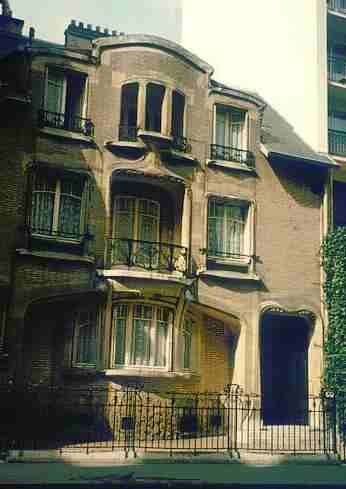 Viollet-le-Duc, he realizes the school of the Sacré-Coeur, avenue de La Frillière. A trip to England, Holland and Belgium in 1894 triggers his taste and belief in Art Nouveau. Especially in Brussels, where he meets and admires Victor Horta, who gave Art Nouveau his marks of nobility. Viollet-le-Duc, he realizes the school of the Sacré-Coeur, avenue de La Frillière. A trip to England, Holland and Belgium in 1894 triggers his taste and belief in Art Nouveau. Especially in Brussels, where he meets and admires Victor Horta, who gave Art Nouveau his marks of nobility.
Guimard identifies himself with Horta's work system and life style. A loner, he likes to design all aspects of his creations, from major volumes down to furniture and even door handles, not to forget the wedding dress of his wife, American artist Adeline Oppenheimer. He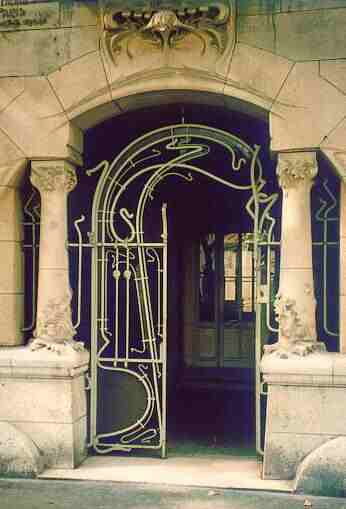 mixes cheap and luxurious materials, creates asymmetric compositions, and diversifies his forms inspired sometimes out of the medieval repertory. Guimard was not only a creative genius but he had a keen business sense, so he mass-produced and marketed some of his ideas and creations. mixes cheap and luxurious materials, creates asymmetric compositions, and diversifies his forms inspired sometimes out of the medieval repertory. Guimard was not only a creative genius but he had a keen business sense, so he mass-produced and marketed some of his ideas and creations.
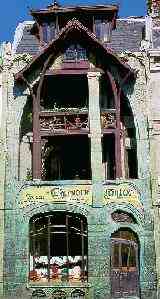
As soon he returns to Paris, in 1895 he builds the famous and delirious Castel Beranger, rue Fontaine (see my articles about on my web site, Paris 16th arr) for Mme
Fournier.
|
|
|
Maison Colliot |
After the building is completed, he uses part of the ground floor as his studio.
The he realizes the entrance of the maison Coilliot in 1899. Paris authorities wanting to design original metro entrances, ask him to do the job since he is the only one to adopt Art Nouveau.
But in 1902, Art Nouveau is out of fashion and Guimard breaks his relation with the metro company. He is very busy now, building in the 16th arr. Hotel Mezzara was built in 1910 for the industrial designer and friend of Hector Guimard, Paul Mezzara. Although the Art Nouveau was actually over by then, the house was still built in that style.
In 1938 Hector Guimard moves to New York, where he dies in 1942 on may 20.
Bibliography
Hector Guimard et l'Art nouveau, by Georges Vigne - Hector Guimard , by Maurice Rheims - Architecture with a smile, Parisian Art Nouveau, stroll no. 9, by Arthur Gillette (Media-Cartes, publ.Paris)
|
